
In March 2025, an attacker moved a few tags in the tj-actions/changed-files repository and thousands of workflows suddenly ran malicious code. The payload dumped CI runner memory, including secrets, into workflow logs on public repositories 1. It wasn't a novel technique. Move a mutable tag, and every workflow that references @v44 silently starts executing something its maintainers never reviewed.
That incident is the reason GitHub published its Actions 2026 security roadmap in March, and the reason parts of it are already shipping by August 2. The roadmap is a blunt admission that CI/CD infrastructure has become a first-class attack surface: runners execute untrusted code, hold sensitive credentials, and have unrestricted outbound network access 2. If you run GitHub Actions in production, or inherit a repo that does, this changes your threat model this year.
The problem: what you review is not what runs
Today, Actions resolves dependencies at runtime. A workflow that says uses: actions/checkout@v4 or @main executes whatever that ref points to at the moment of the run, not what a reviewer approved. There is no lockfile, no deterministic resolver, and no committed record of which commits actually executed 3. Composite actions make it worse: they embed nested uses: steps that only surface after the runner downloads them, so transitive dependencies are effectively invisible to the workflow author 3.
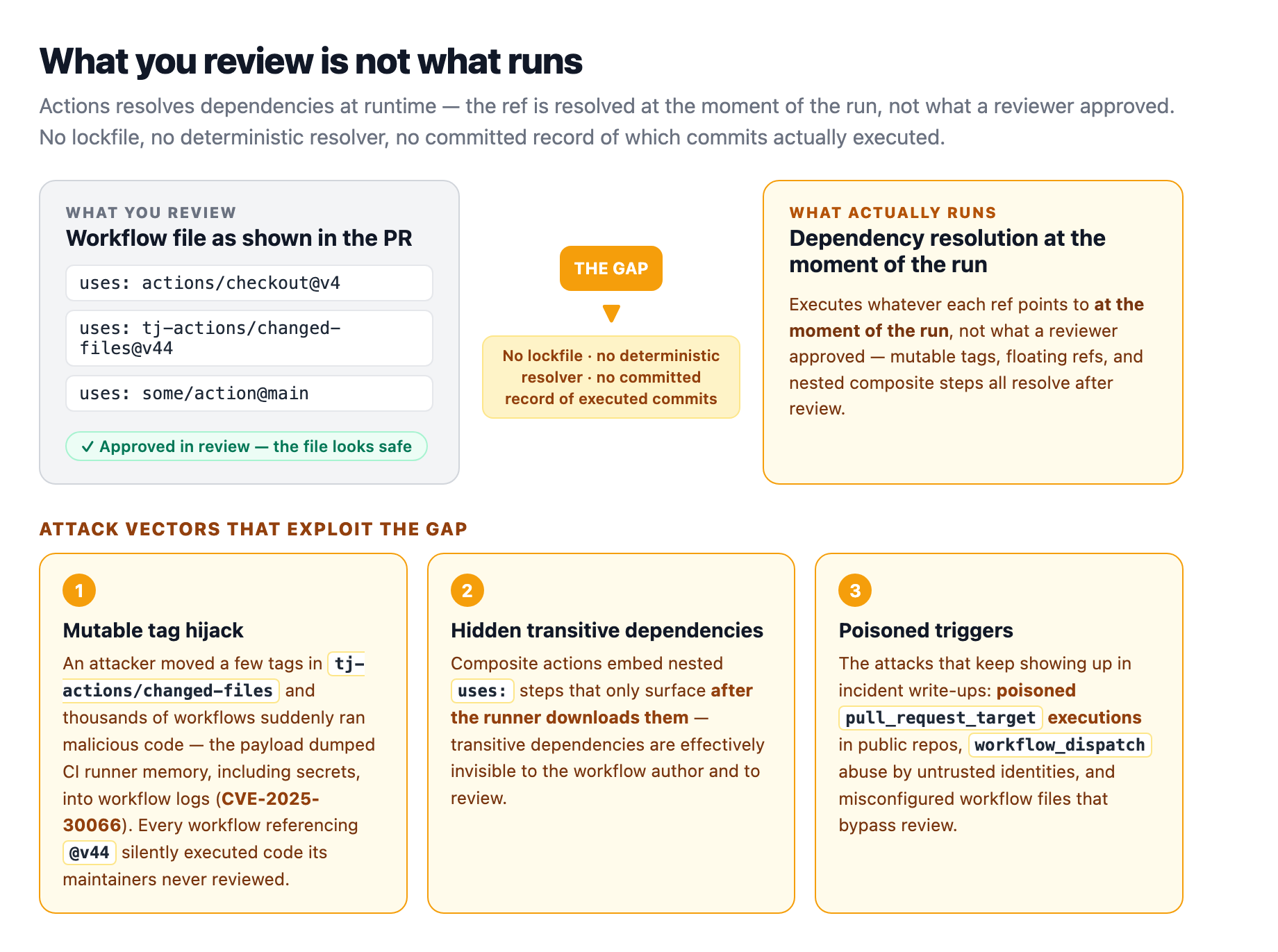
GitHub's own framing is honest: npm, Cargo, Go modules, Bundler, and NuGet all have a manifest + lockfile + deterministic resolver. Actions has none of them 3. The roadmap fixes that gap, then keeps going.
The three layers of the roadmap
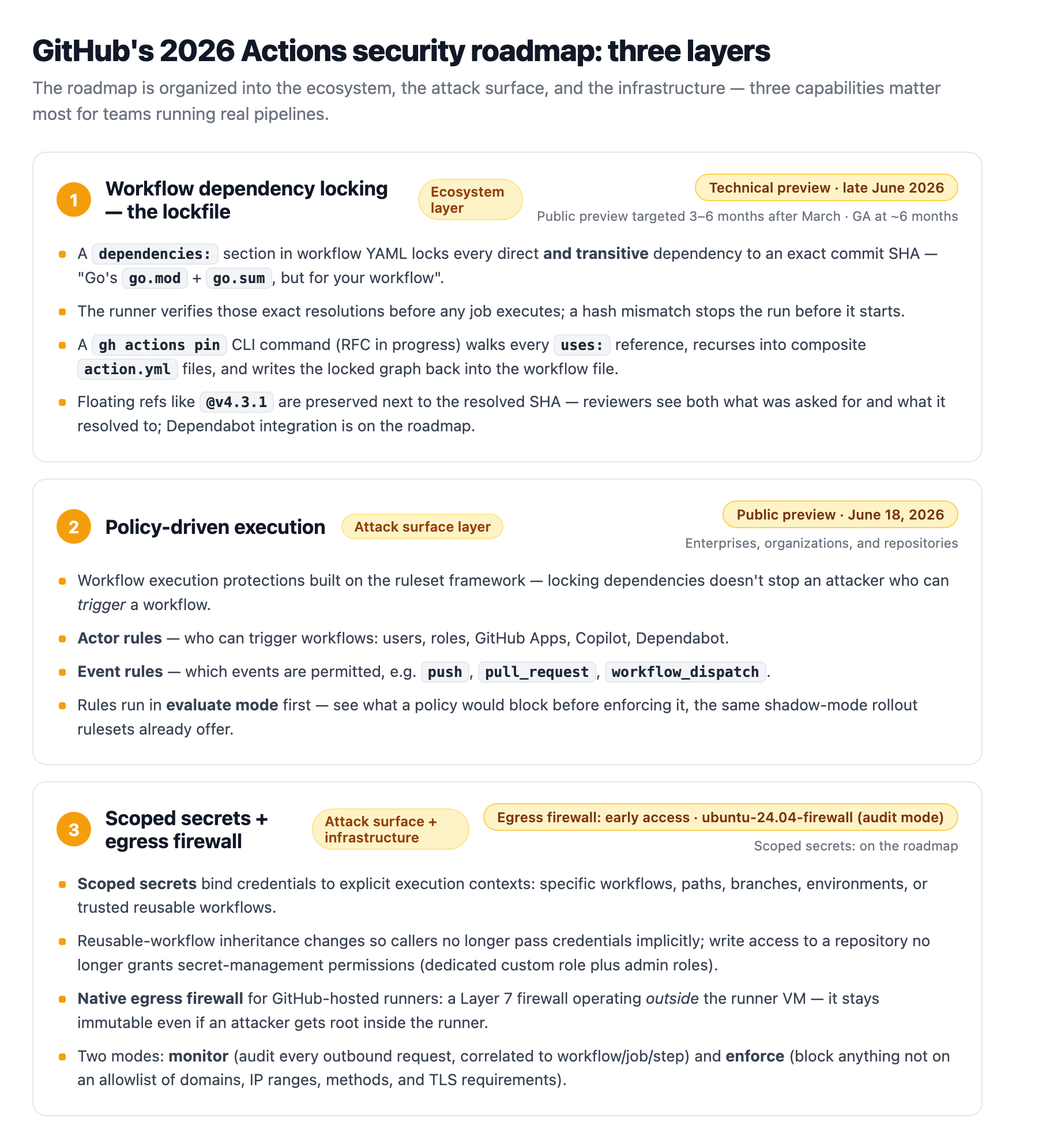
GitHub organizes the work into three layers: the ecosystem (deterministic dependencies, safer publishing), the attack surface (policies, secure defaults, scoped credentials), and the infrastructure (observability and network control for runners) 2. Three capabilities matter most for teams running real pipelines.
1. Workflow dependency locking: the lockfile
The headline item is a dependencies: section in workflow YAML that locks every direct and transitive dependency to an exact commit SHA ("Go's go.mod + go.sum, but for your workflow") 2. The runner verifies those exact resolutions before any job executes; a hash mismatch stops the run before it starts 3.
The design is a gh actions pin CLI command (RFC in progress) that walks every uses: reference, recurses into composite action.yml files, and writes the locked graph back into the workflow file 3. Floating refs like @v4.3.1 are preserved next to the resolved SHA, so reviewers see both what was asked for and what it resolved to 3. Updates become PR diffs instead of silent runtime behavior changes, and Dependabot integration is on the roadmap so pinning doesn't become manual maintenance 3.
Status: dependency lock files entered technical preview in late June 2026, with public preview targeted at roughly 3–6 months after the March announcement and GA at ~6 months 4 2.
2. Policy-driven execution: already in public preview
Locking dependencies doesn't stop an attacker who can trigger a workflow. The second layer is workflow execution protections built on the ruleset framework, and this one is live. As of June 18, 2026, it's in public preview for enterprises, organizations, and repositories 5.
Two rule types ship first: actor rules (who can trigger workflows: users, roles, GitHub Apps, Copilot, Dependabot) and event rules (which events are permitted, e.g. push, pull_request, workflow_dispatch) 5. This directly disrupts the attacks that keep showing up in incident write-ups: poisoned pull_request_target executions in public repos, workflow_dispatch abuse by untrusted identities, and misconfigured workflow files that bypass review 5. Rules run in evaluate mode first, so you can see what a policy would block before enforcing it, the same shadow-mode rollout rulesets already offer 5.
3. Scoped secrets and the egress firewall
Secrets today are scoped to repo or org, which means a compromised step in any workflow can read everything. The roadmap's scoped secrets bind credentials to explicit execution contexts: specific workflows, paths, branches, environments, or trusted reusable workflows, with reusable-workflow inheritance changed so callers no longer pass credentials implicitly 2. The permission model also changes: write access to a repository will no longer grant secret-management permissions; that moves to a dedicated custom role plus admin roles 2.
The infrastructure layer is the native egress firewall for GitHub-hosted runners: a Layer 7 firewall that operates outside the runner VM, so it stays immutable even if an attacker gets root inside the runner 2. It ships in two modes: monitor (audit every outbound request, correlated to workflow/job/step) and enforce (block anything not on an allowlist of domains, IP ranges, methods, and TLS requirements) 2. Early access is already open via the ubuntu-24.04-firewall runner label in audit mode 6.
What already shipped while everyone was reading the roadmap
Two pieces of the roadmap are in production right now, no config required:
- Potentially malicious workflows are held for approval (July 28, 2026): GitHub now detects workflows pushed with compromised credentials and blocks execution until a collaborator with write access approves via an authenticated session. It applies automatically to public repositories 7.
- Actions Data Stream delivers near-real-time execution telemetry (workflow/job details, dependency resolution, action usage) to Amazon S3 or Azure Event Hub / Data Explorer, with at-least-once delivery and a common schema for correlation 2.
What you can do today, without waiting for GA
Every mature practice in this roadmap has a manual equivalent that works right now:
- Pin actions to full commit SHAs (
actions/checkout@<40-char-sha>) instead of tags, and let Dependabot manage the updates so pinning doesn't stall your upgrades 8 3. Remember the honest caveat the community keeps raising: SHA pinning gives immutability, not provenance, so verify the SHA actually exists in the named repository, not an attacker-controlled fork 4. The same gate-first instinct, blocking on secrets and static checks before anything ships, runs through our CI/CD guardrails for AI-generated code. - Set
permissions:to minimum:contents: readby default, escalate per-job 8. - Stop using
secrets: inheriton reusable workflows; pass secrets explicitly so credentials don't flow into every execution path 9. - Audit your dangerous triggers (
pull_request_target,workflow_dispatch,workflow_run,release) and justify each one. These are the Pwn-Requests-style primitives the new execution policies target 10. - Separate secrets by environment trust level and use required reviewers on production environments 10 8.
- Turn on evaluate mode for execution protection rules before enforcing; it shows you what would break before anything does 5.
Adroit on the Ground
Our own publish pipeline is deliberately simple (MDX, build script, commit, push, Vercel auto-deploy), and our verification discipline is the transferable part: we confirm a deploy with layered checks (live URL status, slug in the feed, local HEAD matching origin) rather than trusting the push's self-report, the layered-verification pattern our internal live-app-verification runbook prescribes for our build-posts.js publish flow. That's the same instinct the Actions roadmap is industrializing: verify what actually ran, not what was supposed to run. For client pipelines, the roadmap is a forcing function to get the fundamentals in place now (SHA pinning, minimal permissions, scoped secrets, trigger audits) so the platform-level controls are a reinforcement, not a rescue.
The bottom line
The 2026 roadmap is GitHub conceding that "secure by convention" failed. Mutable refs, implicit secret inheritance, and unrestricted egress are exactly the primitives the tj-actions, Nx, and trivy-action incidents exploited, and the fixes (lockfiles, execution policies, scoped secrets, egress control) are landing in preview through 2026 2. Teams that adopt the manual equivalents now will be ahead of the enforcement wave instead of catching up to it. Start with the lockfile mindset: know exactly what your CI runs, and make any change to it a reviewed diff.
- RFC:
gh actions pin: github.com
Sources
-
GitHub Action tj-actions/changed-files supply chain attack (CVE-2025-30066). wiz.io ↩
-
What's coming to our GitHub Actions 2026 security roadmap. github.blog ↩ ↩2 ↩3 ↩4 ↩5 ↩6 ↩7 ↩8 ↩9 ↩10 ↩11
-
Help Shape Workflow Dependency Locking. github.com ↩ ↩2 ↩3 ↩4 ↩5 ↩6 ↩7 ↩8
-
What's coming to our GitHub Actions 2026 security roadmap (community discussion). github.com ↩ ↩2
-
Control who and what triggers GitHub Actions workflows (public preview). github.blog ↩ ↩2 ↩3 ↩4 ↩5
-
Actions Native Egress Firewall: Early Access. github.com ↩
-
GitHub Actions holds potentially malicious workflows for approval. github.blog ↩
-
Security hardening for GitHub Actions. docs.github.com ↩ ↩2 ↩3
-
Complete Guide to GitHub Actions 2026 Security Roadmap. dev.to ↩
-
GitHub Actions 2026: what the new security roadmap really changes. blog.stephane-robert.info Further reading: ↩ ↩2