
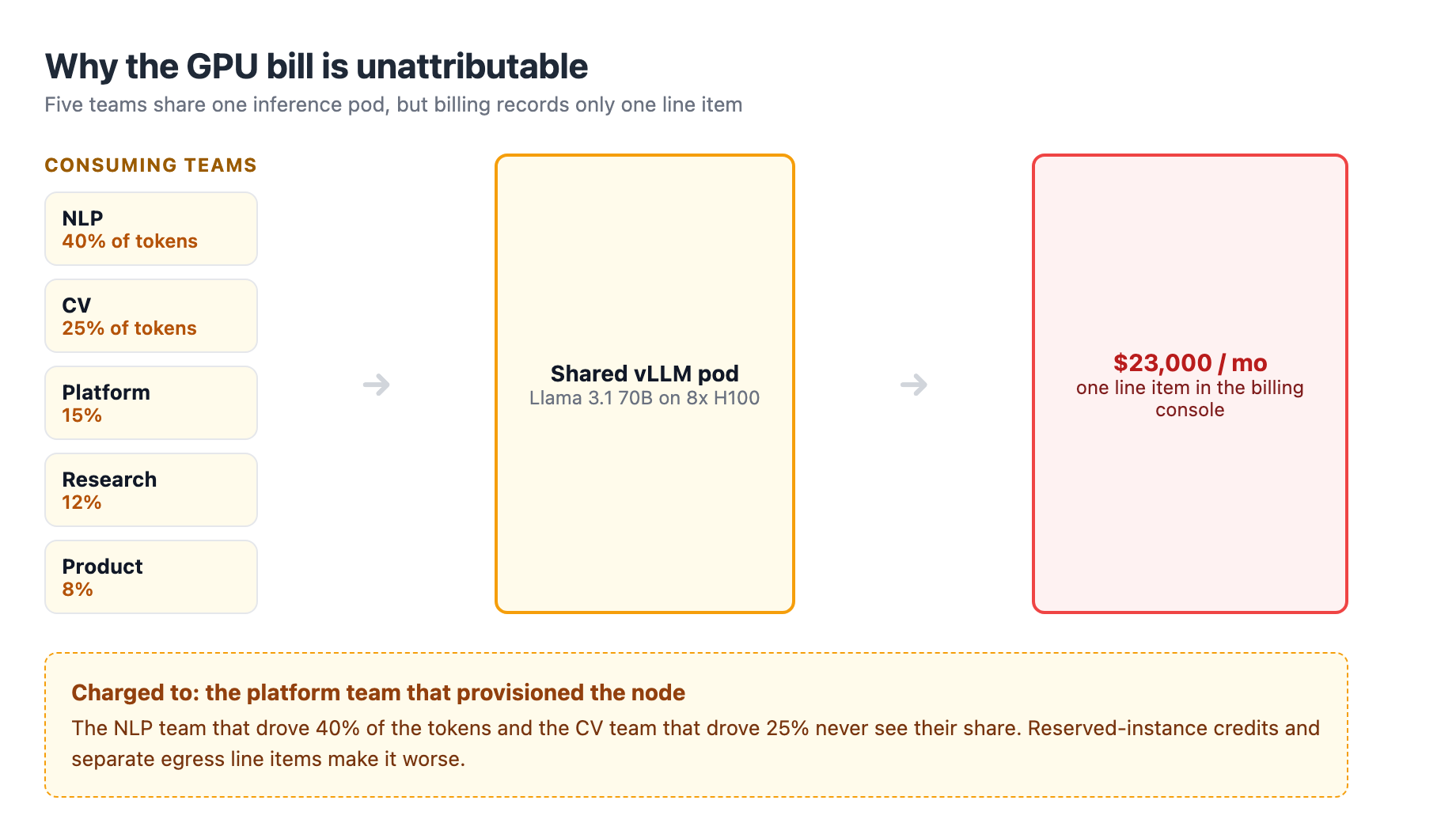
The bill arrives, and nobody can say who spent it. Your finance team sees a single line for an 8x GPU node at a cost that clears most cloud spend, and the platform team that provisioned it takes the blame. The teams that actually consumed the GPUs, the NLP team that drove 40% of the tokens and the CV team that drove 25%, never see their share. That is the central problem of GPU FinOps in 2026: not the size of the bill, but the fact that nobody can attribute it.
This is no longer niche. 98% of FinOps practitioners now manage AI spend, up from 31% two years ago 1, and GPU spend has become the top FinOps concern for AI-first organizations 2. The discipline that worked for EC2 instances is quietly breaking.
Why hyperscaler cost tooling fails on GPUs
AWS Cost Explorer, GCP Billing Console, and Azure Cost Management treat the instance as the unit of cost. That worked when one team ran one virtual machine. A GPU node breaks it in three structural ways.
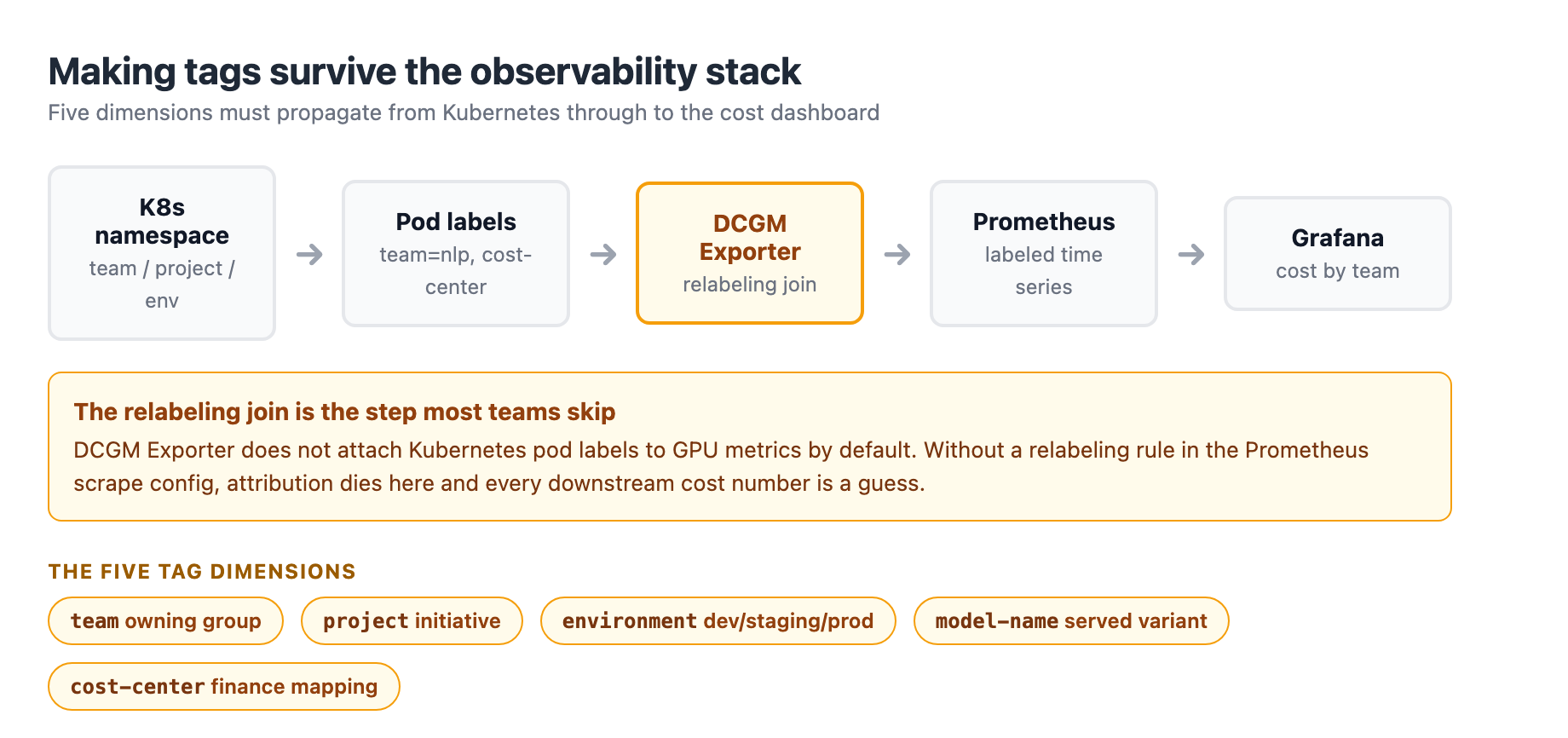
First, attribution stops at the instance. A team=nlp label on a Kubernetes pod does not appear in DCGM Exporter's GPU metrics by default. Tags on the compute instance do not flow into GPU utilization counters or VRAM time series, so without an explicit join in Prometheus relabeling rules, your cost data has no idea which workload owned the GPU 2. Most teams never configure that join.
Second, multi-tenant inference hides the real consumer. One vLLM pod serving five teams shows up as a single line item in your billing console. A monthly inference bill of $23,000 is attributed to the infrastructure team that provisioned the node, not to the product teams whose requests generated the tokens 2. The accounting tells you the platform team is expensive, when the real question is which product owns the spend.
Third, reserved-instance credit pools scramble per-team cost. If you use AWS Savings Plans or committed-use discounts, credits get applied across the account before any cost center sees its number. A team that budgeted $8,000 a month might see $5,200 after credits land, but those credits were earned by a different team's reserved workload 2. Chargeback becomes an accounting exercise nobody trusts instead of an engineering decision.
Egress compounds all of it. GPU egress can add 15 to 25% on top of raw compute, and it appears in a separate line item that team-level attribution almost always misses 2. A 5-team cluster that looks like $22,000 a month on paper can run closer to $43,000 once data transfer, storage, and cross-AZ networking are counted 2.
The four cost-allocation models
There is no single right way to split a GPU bill. The correct model depends on how your teams are structured and how granular finance needs the attribution to be. Most organizations end up running two of these models at once 2.
Per-namespace
The simplest model. Give each team its own Kubernetes namespace, relabel DCGM metrics with the namespace label, and attribute cost by GPU-seconds:
team_cost = (namespace_gpu_seconds / total_gpu_seconds) * cluster_monthly_cost
This suits organizations with three to eight teams that each own distinct namespaces. Its limitation is shared infrastructure: kube-system, gpu-operator, and monitoring namespaces accumulate unattributed overhead you must distribute or absorb into a platform budget 2.
Per-tenant
Handles the common multi-tenant case where several teams share one or more inference pods. It requires a proxy layer, typically LiteLLM, Kong, or nginx, to inject tenant headers before requests reach vLLM. Attribution is token-weighted or request-weighted; token weighting is almost always more accurate, because long 4K-context requests consume far more GPU time than short classification tasks 2.
Per-token
The most granular and the most operationally complex. You read vLLM's /metrics endpoint, which exposes vllm:prompt_tokens_total and vllm:generation_tokens_total labeled by model and request ID, and compute cost per token as gpu_cost_per_second * avg_gpu_seconds_per_token 2. This is what you want if you bill internal product teams or external API customers by the token. It carries a real operational load: per-request latency, a join with GPU utilization, and edge cases like prefix caching, where tokens are processed once but logged against multiple requests.
Per-experiment
Covers training. A training run's cost is GPU count times hours to convergence times hourly rate. The hard part is tagging the jobs: annotate Kubernetes batch jobs and Slurm submissions with team, project, and experiment labels so the cost lands on the right initiative 2. Most teams start at per-namespace and graduate to per-tenant or per-token when shared inference pods become a real line item.
The five-dimension tagging schema
Every allocation model above depends on one thing: consistent tags. The practitioners who make this work use five dimensions that cover roughly 95% of chargeback use cases 2:
team: the owning group, such asnlporcvproject: the specific initiative, such asllama-finetuneorprod-inferenceenvironment:dev,staging, orprodmodel-name: the model variant being served, such asllama-3-70bcost-center: the finance mapping, such asproduct-aiorplatform-infra
Missing any dimension creates a gap: a job tagged with team but not cost-center cannot be reconciled against your finance system's budget lines 2.
The propagation chain is where this usually falls apart. Labels must survive a journey: Kubernetes namespace labels, then pod labels, then DCGM Exporter relabeling, then Prometheus, then Grafana. DCGM Exporter does not automatically join Kubernetes pod labels onto GPU metrics; you need a relabeling rule in your Prometheus scrape config that reads pod labels from kube-state-metrics and applies them to the DCGM time series 2.
For vLLM, setting VLLM_SERVED_MODEL_NAME as an environment variable puts the model name into the model label on vLLM's Prometheus metrics, joinable with GPU cost data in Grafana. Once that pipeline exists, a stacked bar of tokens by team label gives finance a cost picture it can actually read 2.
Showback before chargeback
Once you can attribute cost, the temptation is to start billing teams real money immediately. Resist it. The recommended rollout is four to six weeks of showback first, then chargeback once your tagging coverage is above 80% 2.
Showback is attribution-only reporting. Teams see what they would be charged, but no budget transfer happens. It is a reporting mechanism, not a billing mechanism, and it is the right place to start because it surfaces tagging gaps before they become disputes 2.
Chargeback transfers the actual cost to a team's budget or cost center through a finance system integration. It requires buy-in from finance and team leads, accurate tagging across all workloads, and an agreed approach to shared infrastructure overhead 2. Several warning signs tell you chargeback is premature: tagging coverage below 80%, no team-level budgets in finance, unresolved shared-infrastructure overhead, and tags inconsistent across dev, staging, and prod 2. If any hold, the numbers will be disputed the moment they hit a budget. This mirrors the FinOps Foundation's guidance, which promotes showback specifically because the visibility itself drives behavior change before any money changes hands 3.
The levers that actually cut the bill
Attribution tells you who owns the cost. Cutting it is a separate problem, and the levers are well documented. They fall into three layers 4.
Model-level optimization
Quantization and right-sizing shrink the model's footprint and can cut cost materially; one 2026 FinOps breakdown puts the savings at 30 to 75% 4. A 70B model in FP16 needs roughly 140GB of VRAM for weights alone; AWQ 4-bit cuts that to about 35GB, leaving room for KV cache on a single 80GB device 5. Cost per million tokens on a 70B deployment can drop from about $1.84 to under $0.55 through the right GPU choice, quantization format, serving engine, and infrastructure, and AWQ quantization alone can cut it by around 70% on some hardware 6.
Runtime optimization
Continuous batching, prefix caching, and speculative decoding raise throughput on the same hardware. Continuous batching alone delivers 3 to 5x higher throughput than static batching at the same GPU budget 5. Running Llama 3.1 70B single-stream on one H100 costs roughly $0.60 to $0.80 per million tokens; continuous batching at batch size 8 drops that to $0.15 to $0.25 5. Runtime optimizations across the board report 40 to 80% throughput gains 4, and FP8 quantization on Hopper hardware roughly doubles throughput without changing the hourly price 7.
Infrastructure optimization
Idle capacity is the most expensive line in any inference budget. An idle H100 at $3 an hour burns about $2,160 a month 5. Average GPU utilization across production Kubernetes fleets sits at 5%, and the best-performing cluster in one major dataset, a 136-node H200 deployment, reached 49% 5. Right-sizing closes part of that gap: teams request an H100 80GB for a workload that uses 9GB, the GPU runs at 8% utilization, and it bills at 100% 5. Autoscaling and scale-to-zero close the rest, and for spot-eligible workloads an H100 can run around $0.80 an hour on spot versus $2.90 on demand on some providers 4.
The compounding effect is real. One generative AI company cut GPU infrastructure costs by 70% through node right-sizing, autoscaling-triggered node termination, and spot coverage on non-latency-sensitive inference, without changing its model stack or serving framework 5.
Budgeting rules for a volatile market
The pricing-model choices matter as much as the levers. For predictable training or inference, commit to GPU capacity reservations or committed-use discounts, because on-demand pricing punishes sustained workloads 3. The FinOps Foundation maps the options: reserved instances for predictable GPU-heavy workloads, provisioned capacity for low-latency applications, spot for batch or burst work, and subscription or tiered models for managed platforms 3.
A practical budget rule is to reserve at your P5 utilization floor, the GPU count you run 95% of the time, and use spot or on-demand for burst capacity above that 2. For training specifically, long stateful runs belong on spot with checkpointing, which saves 60 to 70%, while short runs under four hours are not worth the checkpoint overhead 2.
Pitfalls to avoid
Three mistakes recur across most GPU cost analyses.
Do not optimize tokens per second while ignoring utilization: a cluster at low utilization still burns money 4. Do not mix interactive and batch traffic under one autoscaling policy without measuring, because spot capacity suits interruptible jobs far better than latency-sensitive user requests 4. And do not assume serverless GPUs are always cheapest: at very high, stable traffic a dedicated cluster can beat pay-per-call pricing, which is why most teams run a hybrid, baseline load on reserved capacity and bursts on spot or serverless 4.
The through-line is that GPU FinOps requires GPU-native tooling. Cost Explorer extensions and savings-plan dashboards were built for EC2 instances, not for GPU clusters shared across inference and training. The four allocation models give you the right granularity, the five-dimension tagging schema makes the numbers accurate, and showback-to-chargeback sequencing keeps the exercise honest. Start with showback, run it for four to six weeks to find the tagging gaps, then move to chargeback once coverage passes 80% 2. The bill stops being a mystery the day you can say who owns each line.
Sources
-
FinOps Foundation, State of FinOps 2026. data.finops.org ↩
-
Spheron, "GPU Cloud FinOps for AI Teams: Cost Allocation, Per-Project Chargeback, and Tag-Based Budgeting (2026)". spheron.network ↩ ↩2 ↩3 ↩4 ↩5 ↩6 ↩7 ↩8 ↩9 ↩10 ↩11 ↩12 ↩13 ↩14 ↩15 ↩16 ↩17 ↩18 ↩19 ↩20 ↩21 ↩22
-
FinOps Foundation, "FinOps for AI Overview". finops.org ↩ ↩2 ↩3
-
Regolo, "Inference efficiency and GPU cost optimization in 2026". regolo.ai ↩ ↩2 ↩3 ↩4 ↩5 ↩6 ↩7
-
Cast AI, "LLM Inference Cost Optimization on Kubernetes" (Aug 2026). cast.ai ↩ ↩2 ↩3 ↩4 ↩5 ↩6 ↩7
-
Spheron, "AI Inference Cost Economics in 2026: GPU FinOps Playbook". spheron.network ↩