
If 2024 was the year of the demo and 2025 the year of the pilot, 2026 is the year multi-agent orchestration went generally available. Salesforce shipped Multi-Agent Orchestration in Agentforce as the centerpiece of Summer '26, available June 15, letting teams of specialized agents work a single request behind one interface with shared context across channels 1. We covered the configurable mechanics of that release separately in our Agentforce multi-agent orchestration guide. Meanwhile, LangGraph's supervisor pattern became the default answer to "how do I coordinate agents?" in production frameworks 2.
But here's the uncomfortable part: the production data does not say "more agents = smarter." It says topology, handoff contracts, and governance decide whether a multi-agent system helps or hurts. Gartner predicts up to 40% of enterprise applications will include task-specific AI agents by 2026, up from under 5% in 2025 2. That means a lot of teams are about to build orchestration the hard way.
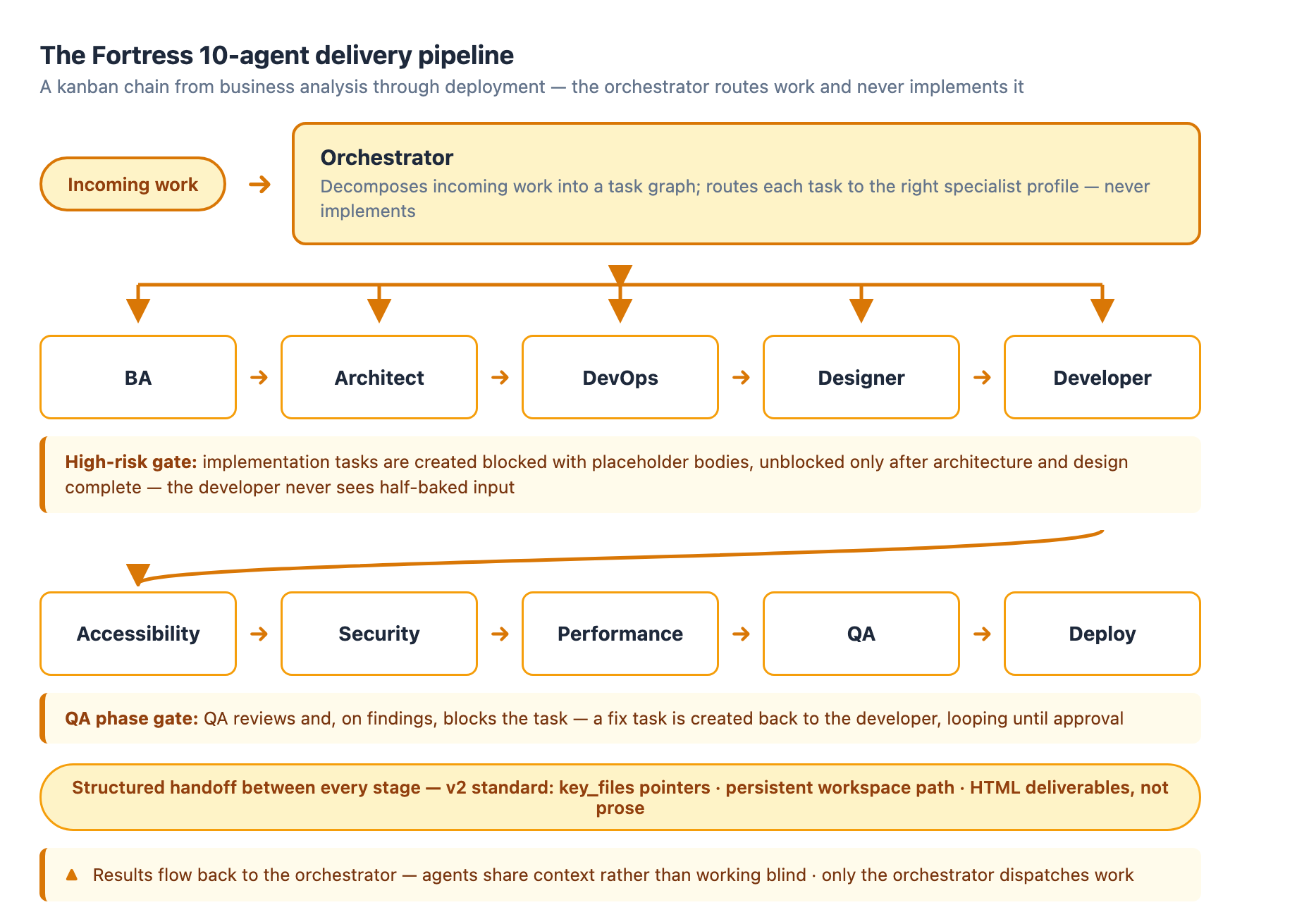
We've been running a 10-agent delivery pipeline daily in our own shop, a kanban chain from business analysis through architecture, design, development, accessibility, security, performance, QA, and deployment, with an orchestrator that routes work and never implements it, per our internal kanban roster. This is our "Adroit on the Ground" report: what survived contact with production, and what we'd tell a client standing up multi-agent orchestration today.
The 2026 verdict: orchestration wins, collaboration is bounded
The industry converged on one pattern for a reason. A 2026 field guide surveying production multi-agent systems splits the design space into three topologies (flow, orchestration, and collaboration) and reports that orchestration is now the clear default, while free-form peer collaboration survived only in heavily instrumented niches 3.
The failure data is blunt about why. The "From Spark to Fire" cascade study showed a single atomic falsehood can spread into system-level false consensus: in LangGraph, injecting an error at the hub produced 100% system-wide failure versus 9.7% from a leaf; final infection rates reached near-saturation across MetaGPT, LangGraph, CrewAI, AutoGen, and Camel 3. A 2026 Google scaling study across 180 configurations found centralized coordination improved a finance agent by 80.9% on parallelizable work, but every multi-agent variant degraded sequential planning tasks by 39–70%, and independent (uncoordinated) systems amplified errors 17.2x versus 4.4x for centralized ones 3.
Anthropic's production writeup is the cleanest reference design: a lead agent spawns 3–5 subagents in parallel, cutting complex-query research time by up to 90%, while burning roughly 15x the tokens of a chat interaction 3. That last number is the hidden cost of every orchestration decision you make.
What our pipeline learned the hard way
We run a 10-stage delivery chain: BA → Architect → DevOps → Designer → Developer → Accessibility → Security → Performance → QA → Deploy. An orchestrator decomposes incoming work into a task graph and routes each task to the right specialist profile; every stage hands a structured deliverable to the next, per our internal kanban roster. It maps almost exactly onto Agentforce's model: a central orchestrator that reads each specialist agent's plain-language description and routes work, with agents sharing context rather than working blind 4. Three lessons transfer directly.
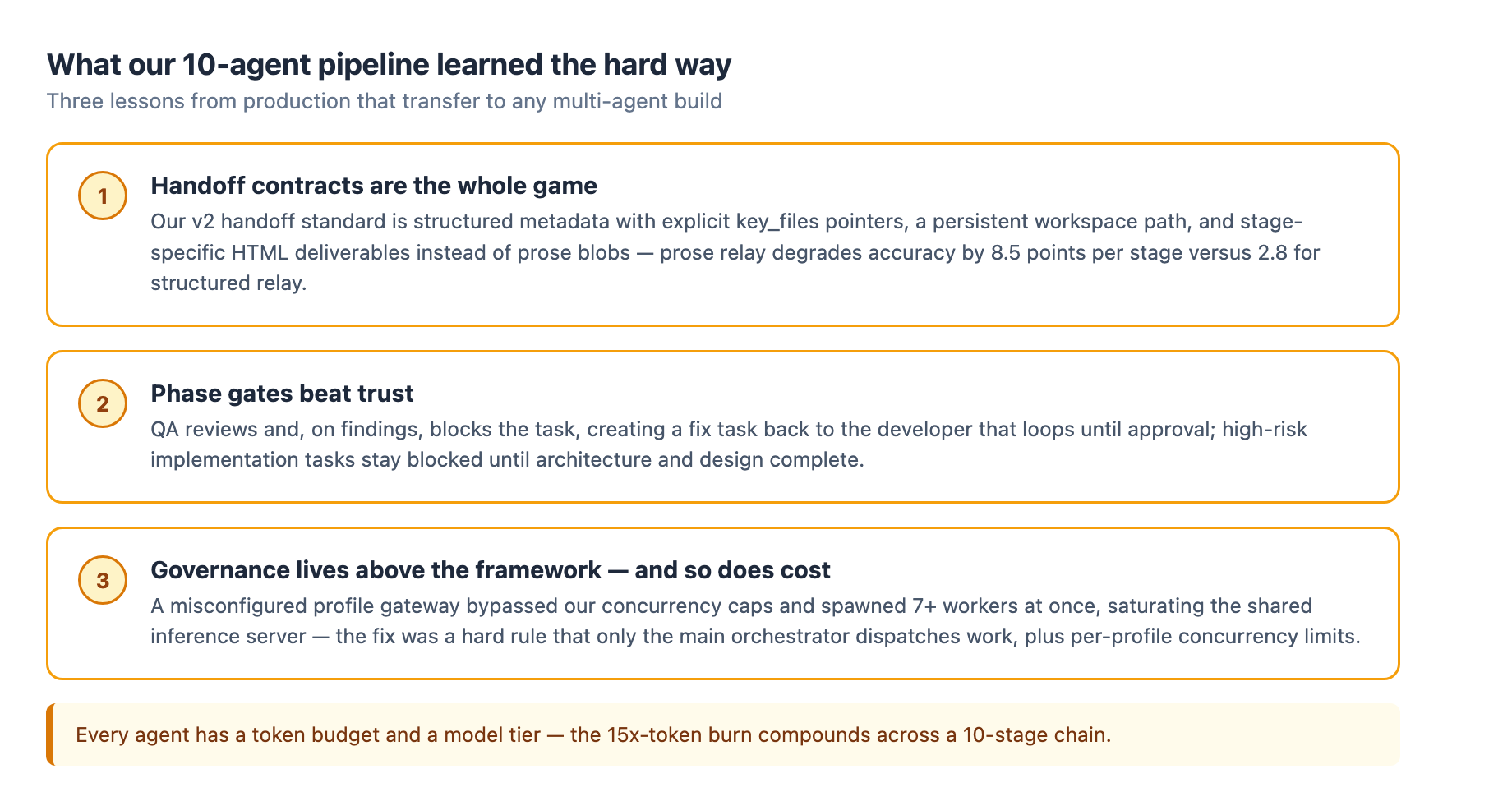
1. Handoff contracts are the whole game. The flow topology's failure signature is that early artifact errors poison downstream stages 3. We learned this early: our first-generation handoffs were free-form prose, and downstream agents regularly misread intent. We moved to a v2 handoff standard: structured metadata with explicit key_files pointers, a persistent workspace path, and stage-specific HTML deliverables instead of prose blobs, per our internal pipeline handoff standards. That's the "aggressive intermediate-artifact schemas and per-stage evaluators" the field guide says flow systems need, not a final grader 3. Prose relay degrades accuracy by 8.5 points per stage versus 2.8 for structured relay in MIT's controlled studies 3. The medium is the message, for machines too.
2. Phase gates beat trust. Our QA stage doesn't just rubber-stamp. It reviews, and on findings it blocks the task and a fix task is created back to the developer, looping until approval, per our internal QA pipeline lifecycle. Cross-agent validation is one of the clearest accuracy advantages multi-agent design holds over single-agent 4. We also gate high-risk handoffs: implementation tasks are created blocked with placeholder bodies and only unblocked after both architecture and design complete, so the developer never sees half-baked input. That's the human-oversight-for-high-risk-decisions pattern the Agentforce rollout guides recommend 4.
3. Governance lives above the framework, and so does cost. TrueFoundry's framework comparison makes the point that no orchestration framework decides what agents can access or what they cost; that belongs to the infrastructure and governance layer above it 2. Our worst production incident was a misconfigured profile gateway that bypassed our concurrency caps and spawned 7+ workers at once, saturating the shared inference server, per our internal kanban roster. The fix was a guard, not a prayer: a hard rule that only the main orchestrator dispatches work, plus per-profile concurrency limits. We also route models deliberately (local inference for routine stages, cloud models for creative and implementation work where the local model produced generic results, and a two-task design split to keep spend at ~$0.60 for the expensive step), per our internal kanban roster. Every agent has a token budget and a model tier, because 15x-token burn compounds across a 10-stage chain 3.
What we'd tell a client starting today
- Start with the supervisor pattern, but only where the task is decomposable. The data is unambiguous that orchestration wins on parallelizable, breadth-first work and loses on tightly sequential tasks 3. Match topology to task shape before you match it to a framework.
- Design the handoff contract before you design the agents. Structured intermediate artifacts with explicit pointers, not prose, are what keep a 5-stage chain from becoming a game of telephone. It's the single highest-leverage engineering decision in a multi-agent build.
- Make routing depend on description quality. Agentforce's Atlas Reasoning Engine routes by reading each specialist agent's plain-language description, so stale or vague descriptions silently misroute requests 4. Keep descriptions current; treat them as production configuration.
- Put governance outside the framework. Concurrency caps, cost limits, access control, and audit logging must live at a layer every agent passes through, not inside agent prompts 2.
- Budget for the token multiplier. Anthropic's own numbers (15x tokens for 90% latency reduction) are the honest trade 3. Plan cost monitoring per agent before you scale, the way you'd monitor per-endpoint latency.
The Agentforce adoption numbers show the industry already voted: $800M Agentforce ARR, up 169% year-over-year, with 2.4 billion agent-driven work units across Agentforce and Slack 4. Multi-agent orchestration is now table stakes for enterprise AI. The differentiator is no longer whether you have agents; it's whether your topology, contracts, and governance survive contact with real workloads. Ours did, and the lessons above are the reason why.
Note: Fortress references in this article describe Adroit's internal multi-agent delivery pipeline (kanban orchestration, handoff contracts, QA phase gates, model routing). Metrics quoted from external studies are as reported by the cited sources; independent verification is recommended before citing them in client materials.