The most instructive AI strategy in retail started with a chatbot named after a bookshelf. In late 2020, Ingka Group, the company behind most IKEA stores worldwide, switched on a customer service bot called Billie. Within three years it was resolving roughly 47 percent of the enquiries it received, around 3.2 million interactions, saving about €13 million in operating costs 1. The interesting part is what Ingka did with the other 53 percent: it studied those conversations, found they clustered around interior design, and reskilled 8,500 call centre co-workers into remote interior design consultants. That channel generated €1.3 billion in sales in FY22, about 3.3 percent of total revenue 1.
Automate a process, read the signal in what the machine cannot do, move people into higher-value work. That sequence is the shape of a real AI strategy. Most companies have the tools without the shape; here is how to build it.
Why an AI Strategy Matters in 2026
The adoption debate is over. McKinsey's global survey found 88 percent of organizations now report regular AI use in at least one business function, up from 78 percent a year earlier 2. Stanford's 2026 AI Index reports the same figure and notes generative AI reached 53 percent population adoption within three years, faster than the PC or the internet 3.
Adoption, though, is not value. Only about one-third of organizations have begun scaling AI beyond pilots, and just 39 percent report any EBIT impact 2. Deloitte's survey of 3,235 leaders found 66 percent report productivity gains from AI but only 20 percent report revenue growth, while 74 percent still hope for it 4. That distance between using AI and profiting from it is closed by strategy, not budget.
PwC's 2026 predictions name the failure mode: companies that crowdsource AI ideas from the ground up get impressive adoption numbers and little else, while front-runners run a top-down program where senior leadership picks a few spots for deep investment 5. A strategy is those choices made deliberately: which workflows get AI, in what order, with what measure of success, and who owns the outcome.
Two shifts make 2026 the year to stop deferring. AI agents went from 12 percent to roughly 66 percent task success on OSWorld, a benchmark of real computer work, in a single year 3. And agents are being embedded into the software you already run: Gartner predicts 40 percent of enterprise applications will feature task-specific AI agents by the end of 2026, up from under 5 percent in 2025 6. AI is arriving inside your stack whether you plan for it or not. Planning is the only part you control.
The Three Waves of AI Adoption
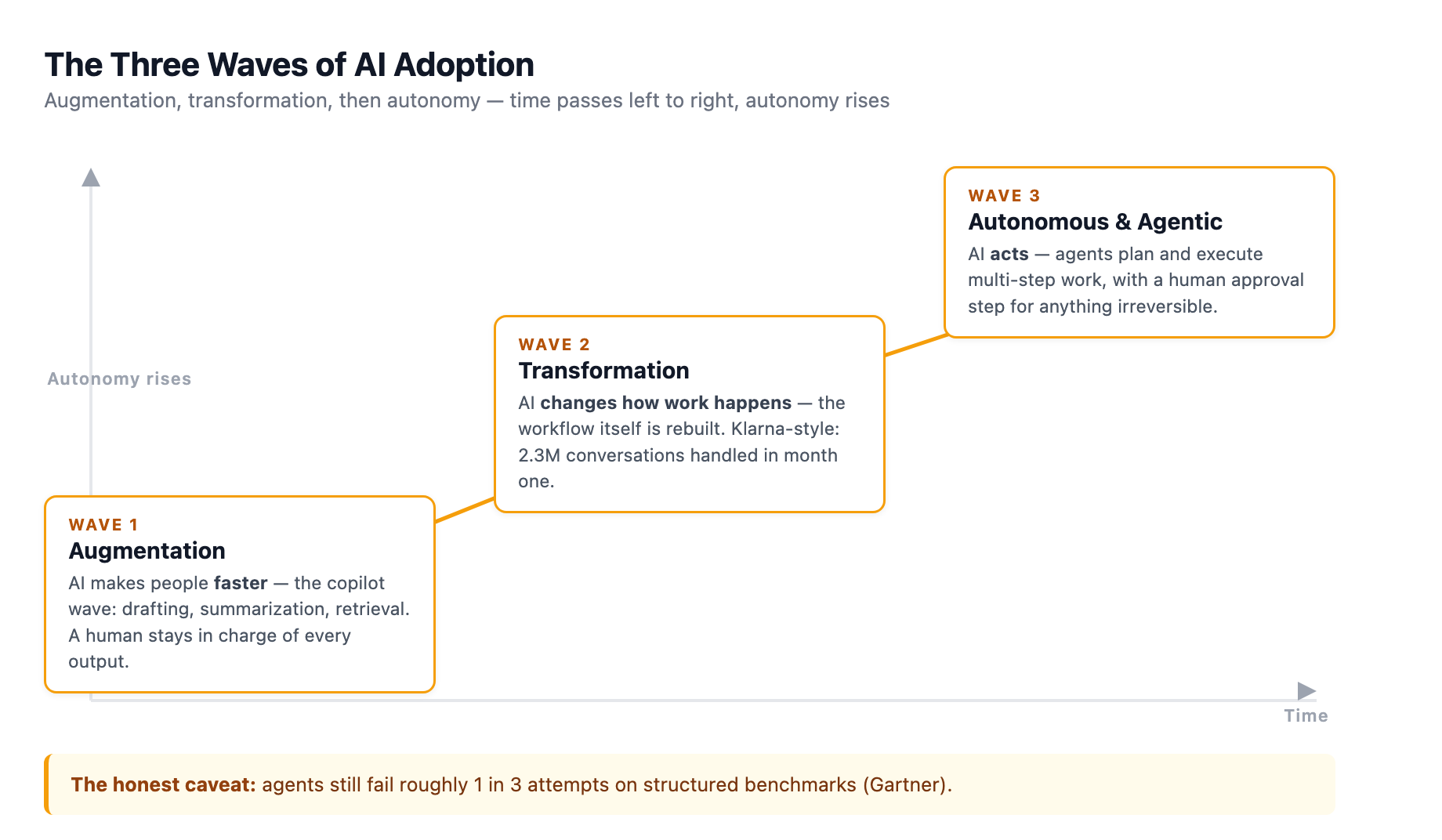
Most AI journeys follow a recognizable arc: augmentation, transformation, then autonomy.
Wave 1: Augmentation, AI That Makes People Faster
This is the copilot wave. AI drafts the email, summarizes the meeting, retrieves the policy, and a human stays in charge of every output. McKinsey's survey shows this is where most usage sits today: conversational interfaces, content support for marketing, and contact-center automation are the most common use cases 2.
Picture a mid-size accounting firm where staff feed invoice data to a model that reconciles it and a senior reviews the exceptions. No process changes, no systems replaced, just faster people.
To apply it: license a capable tool, pick two or three high-frequency tasks, and measure minutes per task before and after. The pitfall: augmentation becomes a permanent ceiling. Deloitte found 37 percent of organizations still use AI at surface level with little or no process change 4. If no workflow is redesigned, the savings quietly evaporate into the same people doing the same work.
Wave 2: Transformation, AI That Changes How Work Happens
Here the workflow itself is rebuilt around AI, people move into adjacent higher-value roles, and the metric shifts from minutes saved to capacity created.
Klarna is the clearest example. In February 2024 it launched an AI assistant that handled 2.3 million conversations in its first month, two-thirds of all service chats, the equivalent work of 700 full-time agents. Resolution time fell from 11 minutes to under 2, repeat inquiries dropped 25 percent, satisfaction stayed on par with humans, and Klarna estimated a $40 million profit improvement for 2024 7.
PwC is blunt about the how: technology delivers only about 20 percent of an initiative's value, with the other 80 percent coming from redesigning the work 5. Ask how AI could create a new workflow, not how it fits inside the old one. Map the process, mark where the agent owns each step, and require review on anything high-risk. That process redesign, AI-first rather than AI-bolted-on, is the first of three forces we break down in our digital transformation deep-dive.
The pitfalls: automating a process that should have been fixed first, and treating transformation as a technology rollout. A broken workflow executed faster just produces errors faster.
Wave 3: Autonomous and Agentic, AI That Acts
Agents plan and execute multi-step work with minimal direction, and intent is running far ahead of deployment. McKinsey found 62 percent of organizations are at least experimenting with AI agents, and 23 percent are scaling them in at least one function, though no more than 10 percent do so in any individual function 2. Gartner's 2026 CIO survey shows the tension from the other side: only 17 percent of organizations have deployed AI agents, yet more than 60 percent expect to within two years 8.
The capabilities are real, and the failures are real too: agents still fail roughly one in three attempts on structured benchmarks, and Gartner places agentic AI at the Peak of Inflated Expectations 8. Sensible deployments look like Deloitte's fieldwork: an air carrier using agents for common transactions like flight rebooking while humans take the complex cases, or a manufacturer balancing cost against time-to-market 4.
Enter this wave safely: constrain the agent to one process with clear boundaries, keep a human approval step for anything irreversible, benchmark it against the human baseline, and log every action. PwC recommends monitoring where agents check each other's work, and for higher-risk scenarios, agents from different model providers so a failure mode is not shared 5. The pitfall is deploying autonomy before governance exists: only one in five companies has a mature governance model for autonomous agents 4.
A Five-Step Framework for Building Your AI Strategy
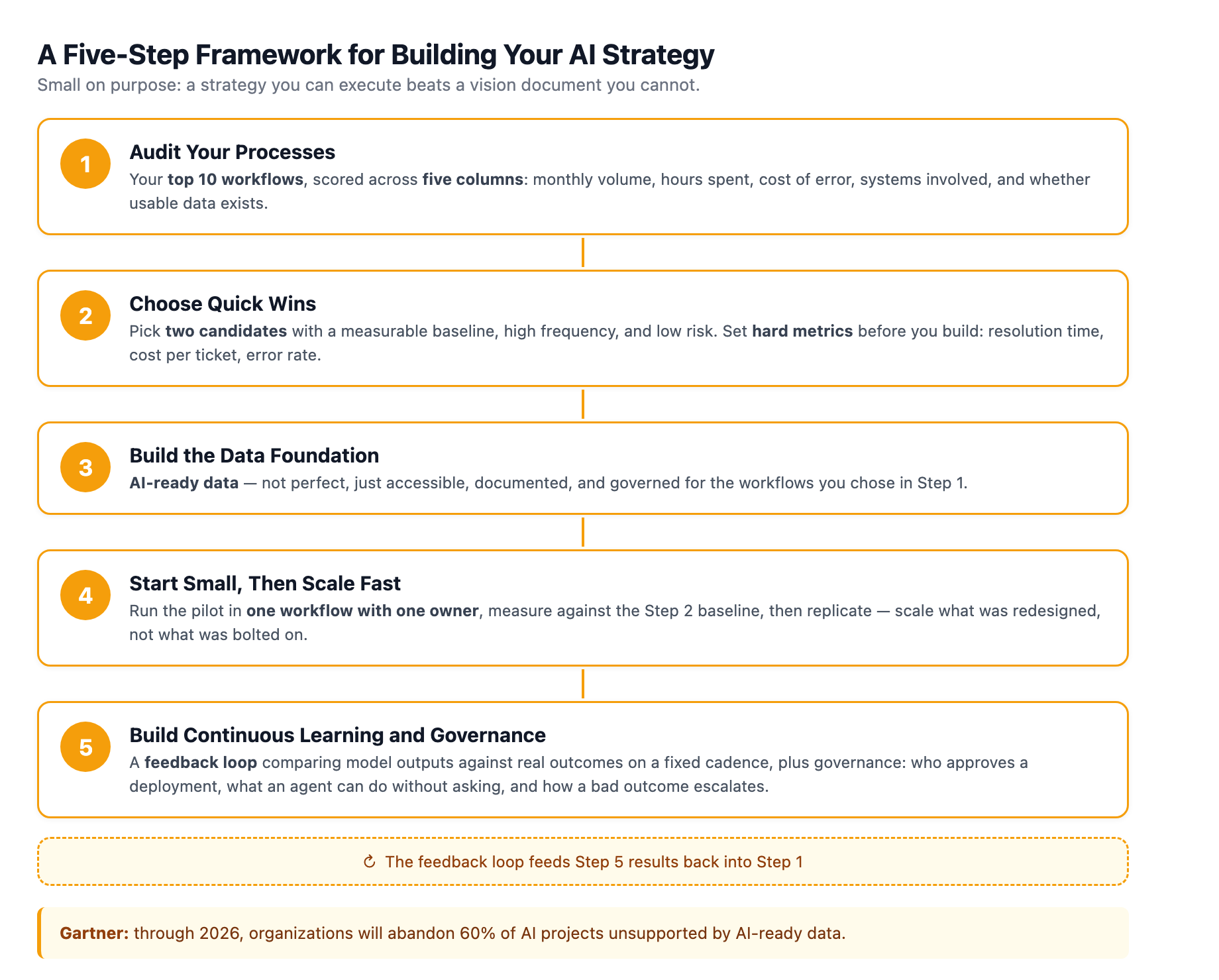
The framework is deliberately small: a strategy you can execute beats a vision document you cannot.
Step 1: Audit Your Processes
Build a table of your core workflows with five columns: monthly volume, hours spent, cost of error, systems involved, and whether usable data exists. Keep it to the ten processes consuming the most people-hours. PwC's rule: leadership picks the spots where business priority, evidence of AI value, talent, and data align 5.
Do not audit the whole company. Analysis paralysis, a quarter spent documenting and nothing shipped, is the pitfall. Two weeks and ten workflows is enough to act on.
Step 2: Choose Quick Wins
Pick two candidates with a measurable baseline, high frequency, and low risk. The classic categories are document-heavy processes, data entry and reconciliation, report generation, and customer communication triage. Set hard metrics before you build: resolution time, cost per ticket, error rate. Klarna's launch is the template: metrics for resolution time, repeat inquiries, and satisfaction published before the tool went live 7.
The pitfall is choosing demo-impressive but low-value pilots. PwC observes that spreading effort across small, sporadic bets is exactly how companies get adoption without outcomes 5. A win only counts if it moves a number the business already cares about.
Step 3: Build the Data Foundation
Gartner predicts that through 2026, organizations will abandon 60 percent of AI projects unsupported by AI-ready data, and 63 percent either lack or are unsure they have the right data management practices for AI 9. Data does not need to be perfect, just accessible, documented, and governed for the workflows you chose in Step 1.
Scope tightly: fix the data feeding your two quick wins, and establish who owns it and how fresh it is. The pitfall is the grand unified data platform that takes eighteen months and ships nothing, or governance deferred until after an incident. Documented AI incidents rose from 233 in 2024 to 362 in 2025, so privacy and bias controls belong in the first build 3.
Step 4: Start Small, Then Scale Fast
Run the pilot in one workflow with one owner, measure against the Step 2 baseline, then replicate. Scale what was redesigned, not what was bolted on. Size dynamics matter: nearly half of companies over $5 billion in revenue have reached the scaling phase, versus 29 percent of companies under $100 million 2. Smaller companies must be more selective.
The pitfall: scaling before the redesign is done, multiplying a mediocre outcome across ten teams.
Step 5: Build Continuous Learning and Governance
Set up a feedback loop comparing model outputs against real outcomes on a fixed cadence, with retraining or prompt updates when performance drifts. Add a governance layer answering three questions: who approves a deployment, what an agent can do without asking, and how a bad outcome escalates. Deloitte found that enterprises where senior leadership actively shapes AI governance get significantly more value than those delegating it to technical teams alone 4.
The pitfall is treating governance as a final gate: it is standing rules, model logs, and escalation paths that run alongside deployments from day one.
Case Study: Ingka Turned a Chatbot Into a New Business Line
This example shows every step of the framework in sequence. Ingka deployed Billie in FY21. Between FY21 and FY23 the bot resolved roughly 47 percent of enquiries it received, about 3.2 million interactions, with close to €13 million in operating savings, and by early 2026 external estimates put its resolution rate near 57 percent 1.
The strategic move came after the automation. Ingka examined the conversations Billie could not resolve and found them clustering around interior design. Customers were not asking whether a sofa was in stock; they were asking whether it would work in their living room. So Ingka reskilled 8,500 call centre co-workers into remote interior design consultants. The new channel generated €1.3 billion in sales in FY22, 3.3 percent of total revenue, with a target of 10 percent by 2028, and an AI literacy program aimed at 30,000 workers, with more than 4,000 trained in FY24 alone 1.
Three decisions made this a strategy, not a project: the AI served a business bet, a paid remote design service, not just a cost save; the work was redesigned; and it was sponsored from the top and funded like a business line.
The honest caveat: Ingka cut around 800 office roles in March 2026 and the Inter IKEA franchisor 850 more in May 2026, driven by declining sales, US tariffs, and weak consumer demand 1. A good AI strategy does not immunize a company against macro shocks. The sequence still stands: automate, read the residual signal, redesign the work, invest in the people.
Your First Month
Week one: audit ten workflows and pick two candidates with baselines. Week two: name an owner, set the hard metrics, confirm the data. Week three: build the smallest version that touches the real process, with human review and logging. Week four: launch to a controlled group and schedule the first review thirty days out.
The cadence matters more than the model or budget. McKinsey found 80 percent of companies set efficiency as the objective, while the high performers add growth and innovation objectives 2. Efficiency pays for the program. Growth is why it exists.
Sources
-
IKEA's AI Reskilling Case, Reassessed After 2026 Layoffs. employerbranding.news ↩ ↩2 ↩3 ↩4 ↩5
-
The State of AI: Global Survey 2025. mckinsey.com ↩ ↩2 ↩3 ↩4 ↩5 ↩6
-
The 2026 AI Index Report. hai.stanford.edu ↩ ↩2 ↩3
-
The State of AI in the Enterprise, 2026. deloitte.com ↩ ↩2 ↩3 ↩4 ↩5
-
Gartner Predicts 40% of Enterprise Apps Will Feature Task-Specific AI Agents by 2026. gartner.com ↩
-
Klarna AI assistant handles two-thirds of customer service chats in its first month. klarna.com ↩ ↩2
-
2026 Hype Cycle for Agentic AI. gartner.com ↩ ↩2
-
Lack of AI-Ready Data Puts AI Projects at Risk. gartner.com ↩