In late 2025, Salesforce replaced the search box on its own help site with an Agentforce-powered assistant. Customers called it slow and inaccurate, and the search bar came back 1. The vendor learned the same lesson you will: an ungrounded agent is worse than a good search box.
Agentforce is now a real platform with real deployments. Salesforce reported 29,000 paid Agentforce deals and roughly $800M in annual recurring revenue in Q4 FY26 1. Yet third-party analysts estimate only about 5.3% of Salesforce's customer base has adopted it, and under 10% of the install base has signed a deal 1. The results are not automatic. This guide covers where Agentforce fits next to Flow, how to deploy without a year-long detour, what to measure, and where projects fail.
What changed: Agentforce is now the platform, not a feature
Most articles about Agentforce are already wrong, because the product moved fast. Agentforce went GA in October 2024 with a flat $2-per-conversation model, then 2.0 (December 2024, Atlas Reasoning Engine), 2dx (March 2025), and Agentforce 3 (June 2025, MuleSoft MCP and A2A support GA) 2. At Dreamforce in October 2025 the stack was rebranded Agentforce 360 and made GA: Data Cloud became Data 360, and new capabilities shipped in the conversational Agentforce Builder, the Agent Script language for deterministic control, Agentforce Voice, and Intelligent Context for grounding on unstructured data 3. Spring '26 finished the renaming, rebranding Sales Cloud as Agentforce Sales; Voice went GA in October 2025 and Contact Center in February 2026 1.
Why it matters: the names in your roadmap meetings changed, and so did the capabilities. The Atlas Reasoning Engine runs a reason-act-observe loop, retrieving grounded data, planning which tools to use, executing, and reflecting on the result, with every decision step logged for observability 4. Usage data backs it: agents per organization nearly tripled over the past fiscal year, time from creation to first use dropped to about two days (down 53%), and output grew at a 15% compound monthly rate as of April 2026 5.
Pandora's Gemma, an Agentforce concierge connected to its order backend and product catalog, handles 60% of routine requests during holiday peaks and drove a 10% NPS improvement while human reps focus on complex interactions 5.
The honest counterweight is accuracy: Salesforce's CRMArena-Pro benchmark put an out-of-the-box Agentforce agent at roughly 35% accuracy before customization 1. The strong customer numbers here all come from configured, grounded, tuned agents. Plan for configuration work, not plug-and-play.
Agentforce or Flow: pick the right tool per task
The most common implementation mistake is treating Agentforce as a Flow replacement. It is not. Salesforce's architect guidance draws the line: use a record-triggered Flow when automation is driven by a DML event with branches fully defined at design time, and use Agentforce when the entry point is unstructured natural language that must be interpreted, classified, and resolved through reasoning 6.
Simple test: is the input structured, is every outcome predictable, and does the process need judgment? An SLA timer that fires on case creation is a Flow, full stop. A customer typing "why is my invoice wrong?" into a chat widget is agent territory. Note that Agentforce is unsuitable for high-volume synchronous record processing where latency is the primary constraint 6.
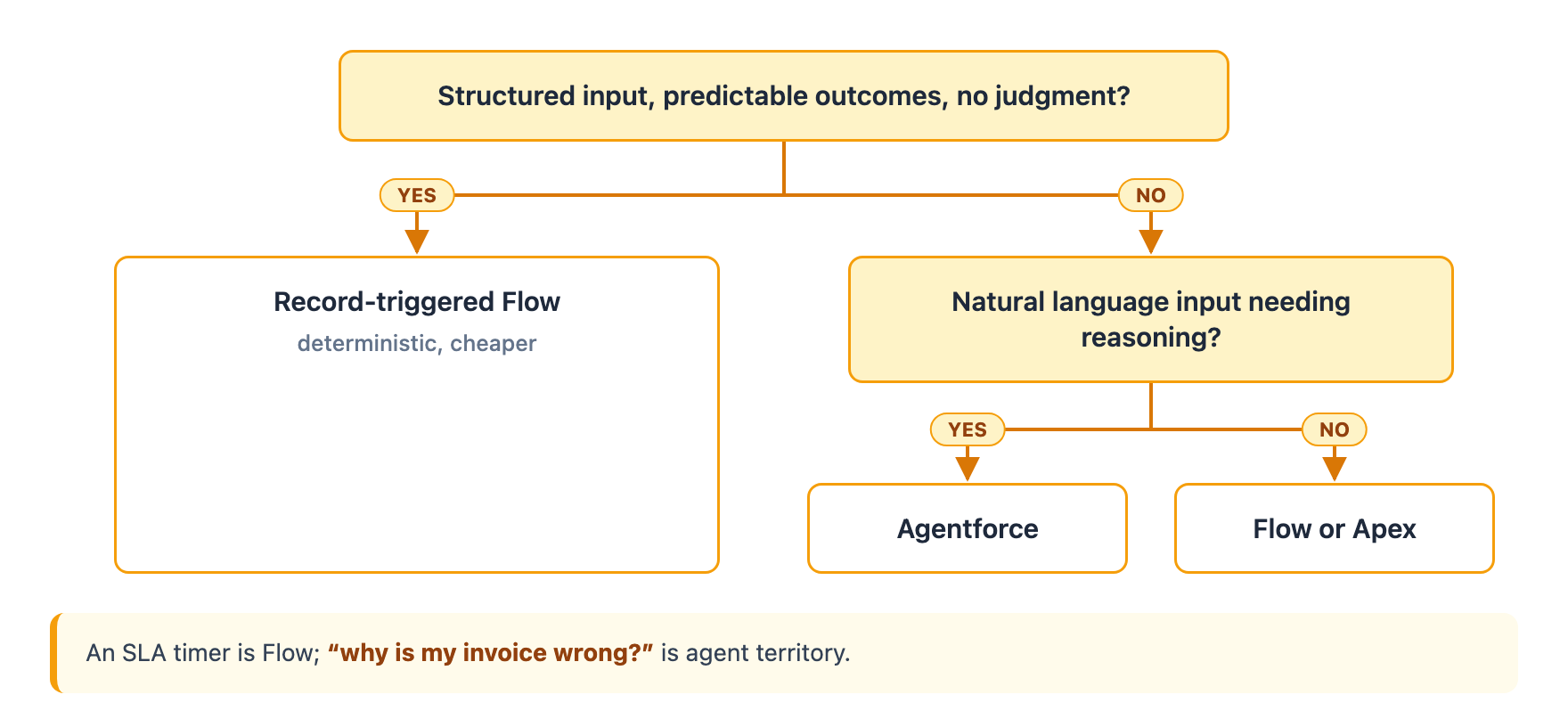
The practical pattern is hybrid: keep deterministic logic in Flows and Apex, then expose those flows as actions the agent can call. Agentforce 360's hybrid reasoning and Agent Script let you define hard rails for tool selection while the LLM handles the judgment parts 3. Audit what you already run in Flow before building anything; most agents orchestrate existing automations rather than replacing them.
Don't agent-wash everything. Flow Orchestration already covers multi-step deterministic processes, and every agent action carries a metered cost; a Flow that can do the job is cheaper and faster. When you do want Flow to call the agent rather than the reverse, that inverse direction is its own pattern, which we cover in our guide to orchestrating Agentforce from Salesforce Flow.
A deployment pattern that survives contact with a real org
Expect a timeline gap: Salesforce markets three-to-six-week deployments, independent analysis puts full enterprise rollouts at 22 to 44 weeks, and a Salesforce SI estimates 4 to 6 weeks for a single use case, 8 to 16 for multi-agent programs 1. The agent is the easy part; org readiness, data hygiene, and governance sign-off are the slog.
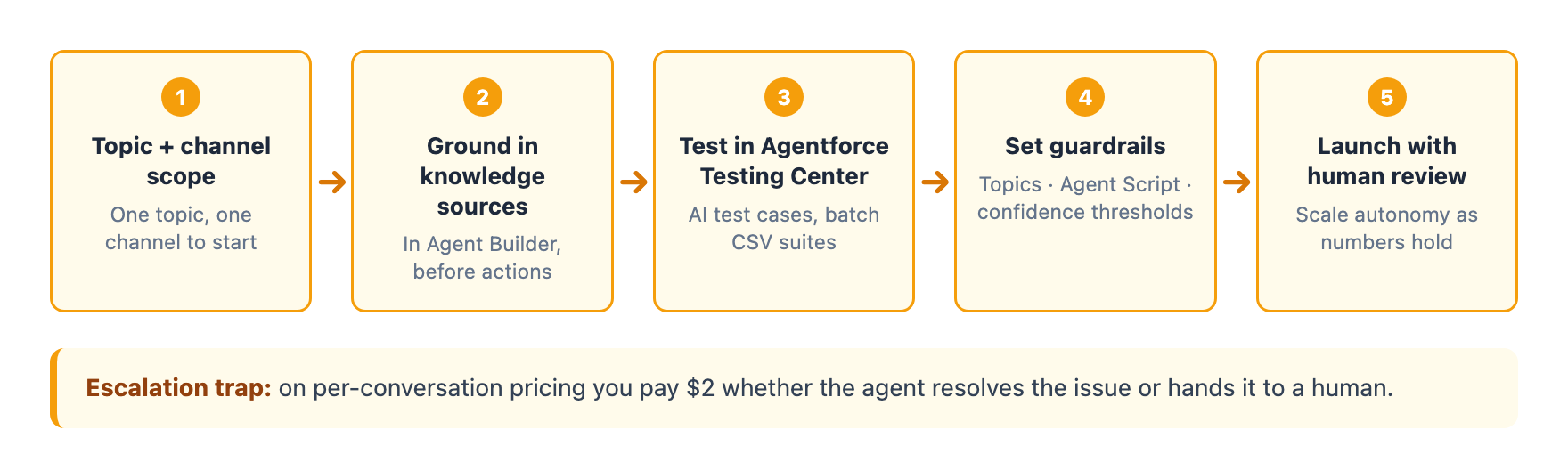
The pattern that works, in order:
- Start with one topic and one channel, not three topics across chat, voice, and Slack.
- Scope it in Agent Builder with topics and instructions, grounded in real knowledge sources before touching actions.
- Test in the Agentforce Testing Center (GA December 2024), which generates AI test cases and runs batch CSV suites in sandboxes at 16 Flex Credits per action versus 20 in production 1.
- Set guardrails: topics bound what the agent will discuss, Agent Script binds what it can do, and confidence thresholds decide when it escalates to a human with full context.
- Launch with human review for the first weeks, then scale autonomy as the numbers hold.
OpenTable is the reference: its restaurant agent resolved 70% of inquiries autonomously within weeks of launch 3. Vendor-reported, but the pattern holds: narrow scope, real grounding, fast iteration.
You can pilot on the free tier: Salesforce Foundations (Enterprise Edition and above) includes 200,000 Flex Credits and 250,000 Data Cloud credits, roughly 10,000 actions before spending a dollar 4.
Two pitfalls dominate. Scope creep: the average agent acted on six skills by the end of 2025, up from two at the start, and retail agents peak at nine during holiday rushes; breadth burns credits and accuracy 5. And the escalation trap: on per-conversation pricing you pay $2 whether the agent resolves the issue or hands it to a human, so a low-confidence agent that escalates everything costs you twice 1.
Measure the right things, and define them before you start
Agentforce Analytics and the Command Center provide the dashboards: deflection rate (sessions ending without escalation to a human), escalation rate, abandonment rate, CSAT, and resolution time 7. The trap: headline numbers mean different things at different companies. Salesforce markets "up to 72% of routine inquiries deflected," its own Customer Zero deployment reports 77% resolution across 50,000+ conversations, and published customer figures range from 25% (GE Appliances) to 95% response accuracy (Heathrow's Hallie) 1. Some are case deflection, some customer-confirmed resolution, some knowledge-deflected sessions where no ticket ever existed.
The numbers are only comparable if the definitions are. Decide yours up front: deflection means the session ended without escalation, resolution means the customer confirmed the answer, contained means no reopen within 48 hours. Instrument a two-week human-only baseline first.
Reddit is the good case: it deflected 46% of advertiser support cases and cut resolution times by 84%, pulling average response time from 8.9 to 1.4 minutes 3.
Watch the paired metrics. A rising deflection rate with a rising abandonment rate is customers giving up, not a win; the Agentforce Analytics training walks through exactly that scenario, deflection at 38% against a 50% goal while abandonment climbs to 27% 7. Review all three weekly and tie deflection to a dollar figure: cost per deflected case versus the fully loaded cost of a human-handled case. That number is what the CFO cares about.
Grounding: Data 360 and MCP are where quality lives
Agent answers are only as good as what they are grounded in. Data 360 (formerly Data Cloud) is the retrieval layer, unifying structured records with unstructured content like knowledge articles, PDFs, and transcripts; Intelligent Context lets agents reason over that material at runtime 3. Every knowledge chunk indexed into Data 360 consumes credits, so ingestion recurs monthly, not just at setup 1.
MCP is the connector layer. Agentforce is a native MCP client, with MuleSoft MCP and A2A support GA since July 2025 2. Vetted servers are discoverable in the AgentExchange catalog and deploy from Agent Builder with no code, while a centralized MCP server registry enforces authentication, granular access controls, and rate limiting 8.
The payoff: Gemma resolves order-status questions by talking directly to the order backend, and Siemens runs a multi-agent workflow where one agent nurtures inbound leads while a second gathers missing data, qualifies it, and routes it across seven business units 5.
Pitfalls: garbage in, garbage out applies harder to agents than to dashboards, since duplicates and messy records produce confident wrong answers 4. Tool sprawl is the second: MCP gives an agent access to everything, but too many tools overload the reasoning loop; start with three to five actions per agent and add as the logs justify it.
Security and governance: defaults are good, gaps are yours
Agentforce inherits Salesforce's permission model: agents respect sharing rules, profiles, and field-level security, and the Einstein Trust Layer adds zero data retention, data masking, and prompt defense so prompts and responses are never stored or used to train third-party models 9. Every Atlas decision is logged, so you get an audit trail point solutions can't match 4.
The governance work is in the edges. PenFed's Ace and Echo agents run behind online banking login, evaluating balances, checking loan status, and transferring funds under strict compliance review 5. That is the model: authenticated entry points, curated knowledge, and explicit approval before an agent writes to records.
The gaps to close yourself: audit every MCP server for what tools it exposes and who can register new ones, watch for prompt injection through customer-facing channels, and review which agent topics can write versus read. Spring '26 is retiring old connected apps in favor of the External Client App framework, so legacy agent integrations need migrating 10. One caveat: Trust Layer masking is reportedly not always applied to Agentforce data because masking degrades answer quality, so verify what is masked before promising regulators anything.
What it actually costs
Salesforce publishes real rates, unusual in this category. Three models exist: Conversations at a flat $2 per 24-hour session (customer-facing agents only), Flex Credits at $500 per 100,000 credits with a standard action at 20 credits (about $0.10) and voice at 30 ($0.15), and per-user licenses from $5 per user per month up to a $125 flat fee 11. Flex Credits and Conversations cannot be mixed in the same org, so pick your billing model before you build 4.
Do the arithmetic before launch. A typical support interaction runs 5 to 15 actions, $0.50 to $1.50 on Flex Credits versus $2 flat on Conversations; high-volume simple work favors Flex, long dialogs the flat rate 12. A support agent handling 100,000 actions a month runs around $10,000 a month in Flex Credits before Data 360 ingestion and licensing 4. Third-party estimates put implementation at $50,000 to $150,000 upfront plus $10,000 to $25,000 a month ongoing 1.
Agentforce is a platform-scale investment for organizations already committed to Salesforce. Scoped narrowly, grounded in real data, guarded with topics and Agent Script, and measured on definitions you set yourself, it is a working automation layer. Org readiness, data hygiene, and weekly tuning decide whether your agent is a 35% pilot or a 70% production system.
Sources
-
Salesforce Agentforce: Features, Pricing & Limitations (2026). myaskai.com ↩ ↩2 ↩3 ↩4 ↩5 ↩6 ↩7 ↩8 ↩9 ↩10 ↩11
-
Salesforce Announces Agentforce 3. salesforce.com ↩ ↩2
-
Welcome to the Agentic Enterprise: With Agentforce 360, Salesforce Elevates Human Potential. salesforce.com ↩ ↩2 ↩3 ↩4 ↩5
-
Agentforce: The Complete Guide (2026). getmacha.com ↩ ↩2 ↩3 ↩4 ↩5 ↩6
-
Salesforce Agentic Enterprise Index 2025-2026. salesforce.com ↩ ↩2 ↩3 ↩4 ↩5
-
Determining Agentic and Traditional Workflow Automation (Architect decision guide). architect.salesforce.com ↩ ↩2
-
Monitor Agent Metrics and Performance Insights (Agent Analytics trail). trailhead.salesforce.com ↩ ↩2
-
Agentforce MCP Support. salesforce.com ↩
-
Trusted AI: Key Principles (Einstein Trust Layer). salesforce.com ↩
-
Salesforce Spring '26 Release. salesforce.com ↩
-
Agentforce Pricing. salesforce.com ↩
-
Salesforce Agentforce Credits & Cost Model: Complete Guide 2026. jitendrazaa.com ↩