
Every two weeks your team sits down, names what went wrong, and writes down a few things it will change. Then the sprint starts and the list quietly dies. This is the least discussed failure in agile delivery, and it is the most expensive one, because it is the failure that guarantees every other meeting stays broken. The retrospective is the only ceremony whose entire job is to change how the team works. If its output never lands, then the sprint review keeps reviewing the same problems, planning keeps planning around the same bottlenecks, and the team improves exactly never 1.
The data says most teams are in exactly this position. Across the teams Easy Agile studied, fewer than half of retrospective action items were ever completed, and a PMI community poll found that nearly two-thirds of respondents implemented under 25% of the ideas their retrospectives produced, while no respondent reported implementing more than 75% 1. Teams are not failing to reflect. They are failing to follow through. And in 2026, with AI compressing the build phase of delivery, follow-through is the thing that separates a delivery engine from a treadmill.
The retro already works. The follow-through doesn't.
The retrospective is not the problem. Reflection is cheap, and most teams are good at it. Sit a group of smart engineers in a room for forty-five minutes and they will name the real blocker, whether it is a missing test environment, an approval chain, or a flaky integration. The discussion is usually honest and occasionally excellent. The ceremony is working 2.
What breaks is the space between the meeting and the next one. Easy Agile's own usage data tells the story plainly: teams using its retro tool completed 40 to 50% of their action items, and after the company added features that surfaced and tracked incomplete actions, that completion rate jumped to 65% 1. The tooling change did not make the team reflect better. It made the follow-through visible, and visibility alone recovered fifteen points of completion. The improvement was not in the meeting. It was in the days after it.
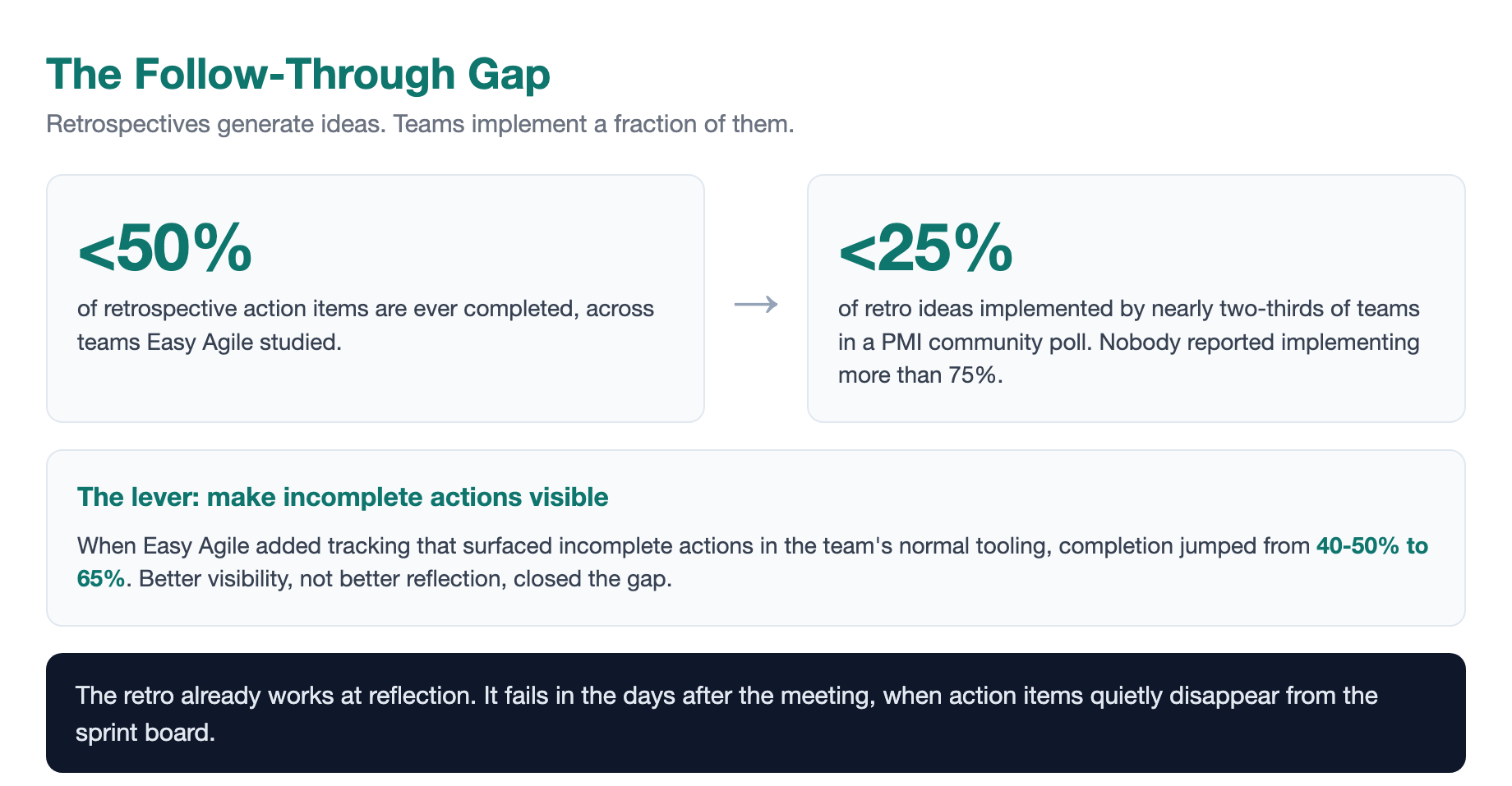
The pattern repeats across every source I looked at. Scrum Poker's catalogue of retrospective anti-patterns leads with the same three: skipping the retro when the team is busy, turning it into a blame session, and never following up on the action items it produces 2. Stefan Wolpers, who maintains one of the most exhaustive lists of Scrum anti-patterns in the industry, frames the whole problem as unfinished action items, the single most cited reason a retro stops producing value 3. Nobody disagrees about what the retro is for. The disagreement is only about whether anyone is held to it.
The reasons follow-through collapses are consistent. Action items get assigned to "everyone," which means no one. They have no deadline, so they drift behind the sprint work. They are written as intentions, "improve communication," rather than actions, "put the weekly sync on the calendar by Friday." And because the sprint board fills up with client work, improvement tasks become side quests that the team abandons the moment a deadline bites 1 3. None of this is a reflection problem. It is a design problem in how the team converts a decision into a change.
Why the retro is the first ceremony to go
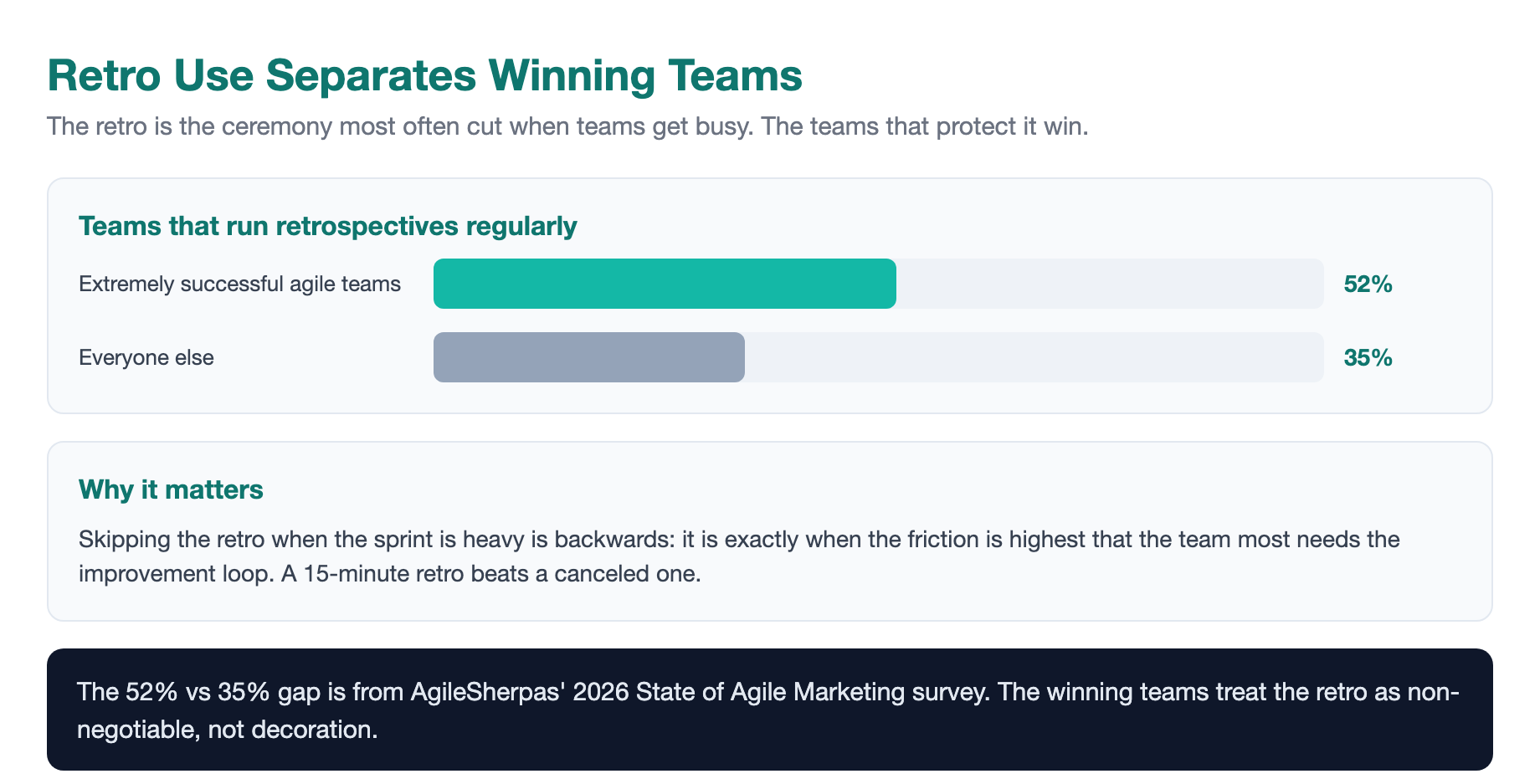
The retrospective is also the ceremony most teams cut first, and that is a signal about how they actually value it. AgileSherpas' 2026 State of Agile Marketing survey found that retrospectives are the practice most likely to be skipped when teams get busy, and the split is stark: 52% of extremely successful agile teams use retrospectives regularly, versus 35% of everyone else 4. The teams that are winning are the ones that protect the retro when pressure hits. The teams that are struggling are the ones that treat it as optional decoration.
Skipping the retro when work is heavy is backwards in a specific way. The whole point of the meeting is to remove the friction that made the sprint heavy. If you cut it precisely when the friction is highest, you guarantee the friction stays. Scrum Poker makes the point directly: skipping the retro when the team is busy is counterproductive, because that is exactly when the team needs improvement most 2. A fifteen-minute retro beats a canceled one. A canceled retro is not a saved meeting. It is a committed decision to run the next sprint the same way as the last one.
The other reason the retro fails is safety. A retro only surfaces the truth if the team believes the truth is welcome. The classic anti-pattern is the blame game, where the discussion becomes an accounting of who did what wrong, and everyone learns to keep their mouth shut 2. The manager effect is the quieter cousin: when an authority figure is in the room, people self-censor and share only what is safe 2. A retro that cannot hear the real problem is a retro that will produce polished, useless action items about things nobody actually cares about.
The fix is to treat the retro like a delivery
The teams that close the follow-through gap do not run fancier retrospectives. They run the same retrospective, then they run a small, disciplined delivery process on top of its output. Wolpers distills it to five practices, and they map almost exactly onto how a good sprint is run: limit the number of action items to one to three high-priority items instead of a long wish list; give each item a specific owner and a delivery date; start every retro by reviewing the status of the previous sprint's items; track items on a public board so they cannot quietly disappear; and pull improvement items into sprint planning so they get the same treatment as client work 3.
The last one is the load-bearing change. When an improvement item is a real sprint task with an owner, a date, and a review point, it survives. When it is a sticky note on a wall, it does not. Easy Agile's 65% result came from exactly this: making incomplete actions visible in the team's normal tooling rather than in a separate retrospective app that nobody opens 1. Visibility is not a nice-to-have. It is the mechanism.
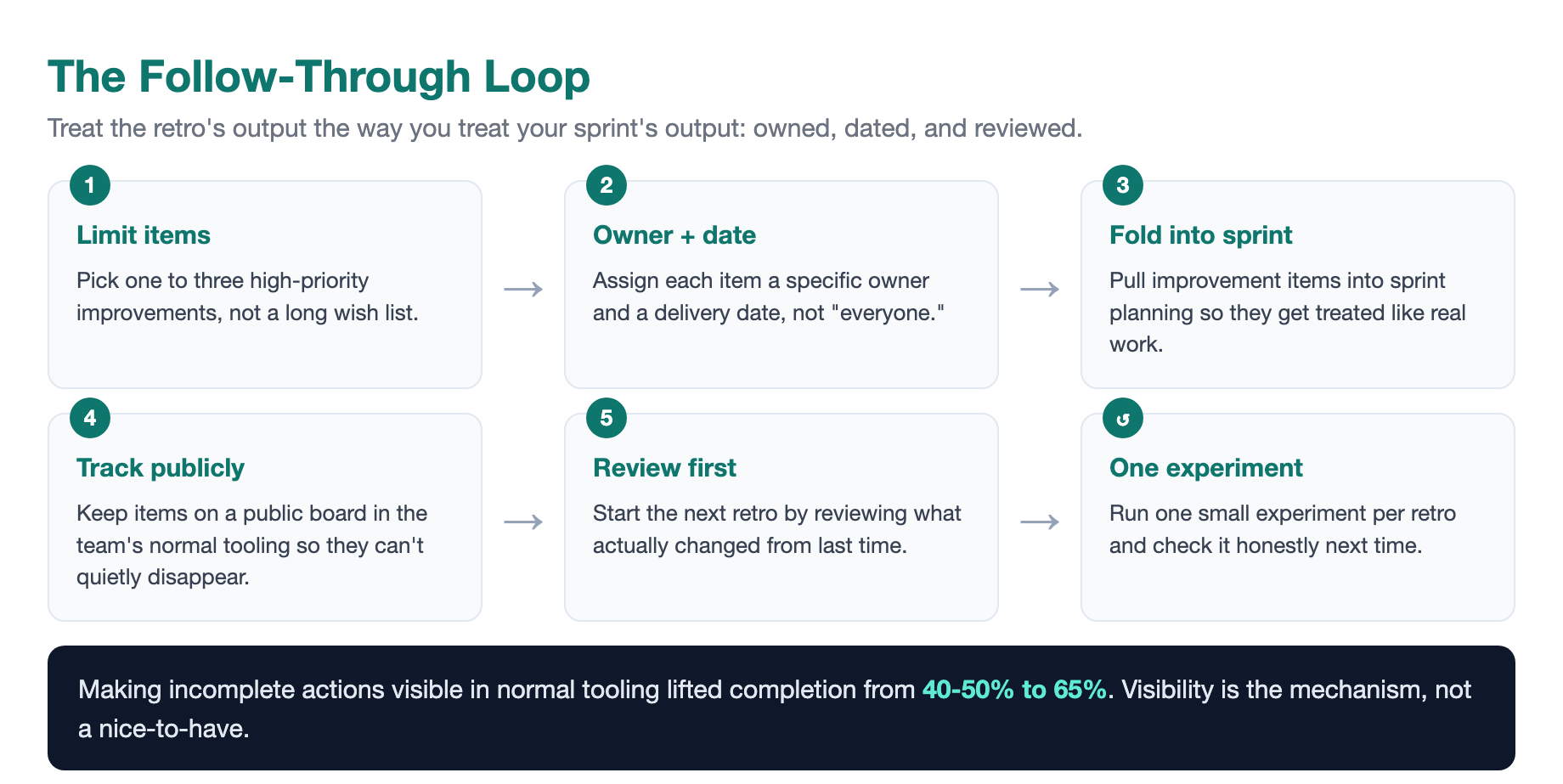
The single most effective framing, though, is to make every retro a small experiment. Echometer's 2026 Scrum best-practices guide is blunt about it: a retro is not successful because everyone spoke openly, it is successful when the team recognizes a pattern, decides on one small experiment, and checks that experiment at the next retro 5. One effective measure beats a list of ten, because ten items guarantee that none of them get the attention they need. The experiment framing also changes the emotional register. An experiment is not a promise to be perfect. It is a hypothesis to test, which makes it safe to try and safe to abandon if it does not work.
What AI changes about the retro
The AI era makes all of this harder, and most teams have not caught up. The Echometer community survey of agile practitioners in mid-2026 found that 45% of teams use AI only as individual experimentation, with no defined workflows or shared guidelines, and 36% reported no change to their day-to-day coordination despite adopting AI 6. The team-level mechanism, the thing that would show up in a retrospective as a pattern worth fixing, is largely invisible because nobody has instrumented it.
There is a harder finding buried in the same survey. Asked how well management understands team health and performance blockers, 56% of respondents said management does not understand it at all or only imprecisely, and 31% called it a complete blind spot. Even more telling for the retro: 52% said error culture is context-dependent, meaning critical issues get voiced inside the team but people fall silent the moment management is present 6. That is the retro's safety problem, measured. If the people who most need to hear the truth are the people whose presence silences it, then the retro needs a way to collect honest signal without the manager in the room.
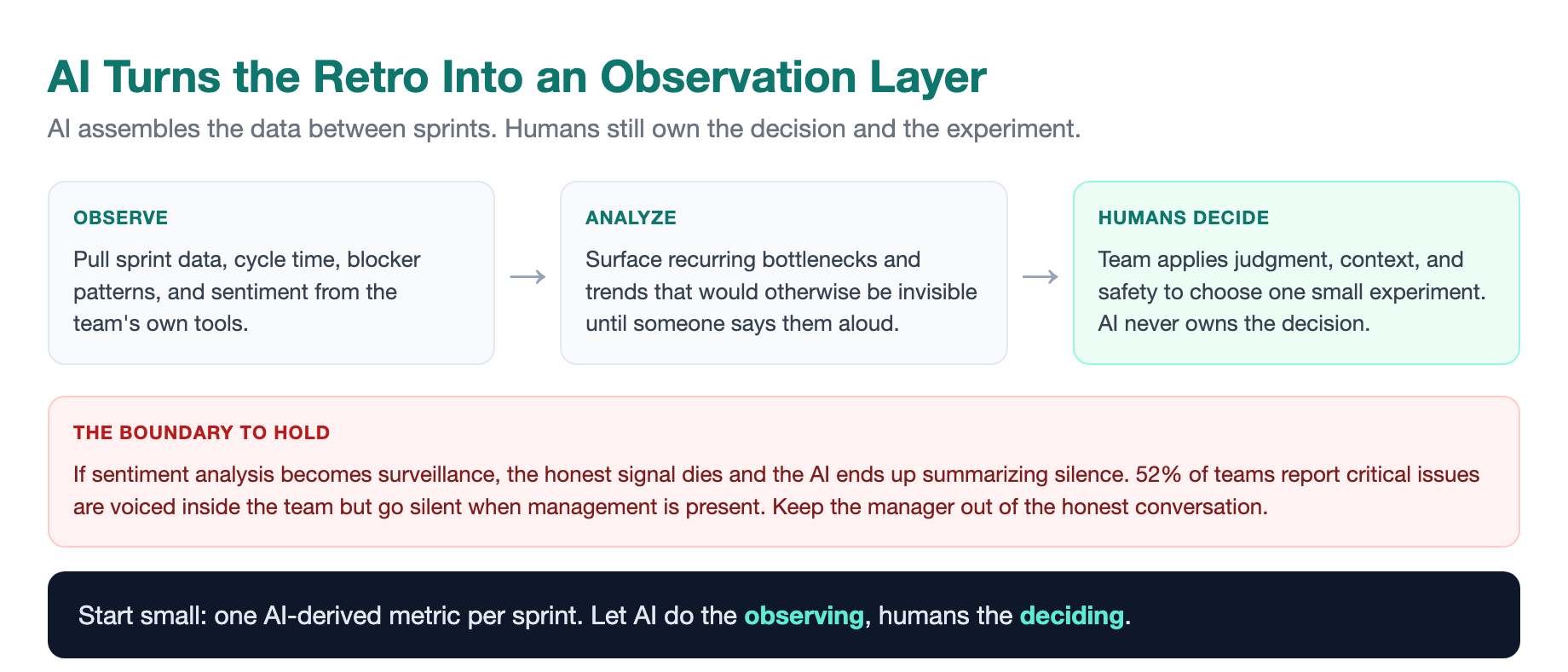
AI does offer the retro something real: a way to observe between ceremonies instead of relying on what people remember in the room. AI retrospectives pull sprint data, cycle time, blocker patterns, and even sentiment from the team's own tools, then surface trends and recurring bottlenecks that would otherwise be invisible until someone says them out loud 7. That is a genuine upgrade to the observe half of the continuous improvement cycle. Instead of reconstructing the sprint from memory in a one-hour meeting, the team walks in with the data already assembled 8.
But the boundary matters, and the tools that cross it are the ones to be careful with. AI can assemble the observation and even propose actions, but it should never own the decision, because the decision is where the team's judgment, context, and safety live. KnowledgeHut's guidance is the right default: use AI to inform the discussion, then let the human team decide, and start small with one AI-derived metric per sprint rather than flooding the retro with dashboards 7. The risk on the other side is that AI sentiment analysis becomes surveillance, which is the fastest way to kill the psychological safety the retro depends on. If the team suspects the tool is grading them, the honest signal disappears and the AI ends up summarizing silence.
Where this lands in a consulting practice
The retrospective is not a soft, people-focused ritual that lives in a different world from delivery mechanics. It is the mechanism by which a delivery team actually gets better at the work it is paid to do, and it sits downstream of the same Definition of Done contract that every increment must meet before review. In our own delivery pipeline, the version of this that works is the same one the data supports: every run ends with a small set of owned, dated checks, and nothing is considered done until those checks pass and a human reviews the result. The rule that makes it hold is not the meeting, it is that the output has an owner, a deadline, and a visible review point. Treat the retro's output the way you treat your sprint's output, and the gap closes.
None of this requires a new framework or a new tool. It requires treating the retro like a delivery instead of a debrief. Limit the action items, assign owners and dates, fold them into the sprint as real work, track them publicly, and start the next retro by reviewing what changed. Run one experiment at a time and check it honestly. If you protect the ceremony when the sprint is heavy, keep the manager out of the honest conversation, and let AI do the observing while humans do the deciding, the retrospective stops being the meeting everybody quietly resents and becomes the one meeting that is actually improving the next one.
Sources
-
Easy Agile, "Why Your Retrospective Isn't Broken, But Your Follow-Through Might Be." easyagile.com ↩ ↩2 ↩3 ↩4 ↩5
-
Scrum Poker, "Retrospective Anti-Patterns to Avoid." scrumpoker.me ↩ ↩2 ↩3 ↩4 ↩5
-
Stefan Wolpers, "Ditch the Unfinished Action Items: How to Make Retrospectives Lead to Real Change." berlin-product-people.com ↩ ↩2 ↩3
-
AgileSherpas, "The 2026 State of Agile Marketing: A Deep Dive Into What the Data Is Really Telling Us." agilesherpas.com ↩
-
Echometer, "Scrum Best Practices 2026: What Works, and What Doesn't." echometerapp.com ↩
-
Echometer, "AI in Agile Software Development: Echometer Community Survey 2026." echometerapp.com ↩ ↩2
-
KnowledgeHut, "AI Agile Retrospectives: Data-Driven Sprint Improvement." knowledgehut.com ↩ ↩2
-
AgileSeekers, "Using AI to Drive Continuous Improvement Across Agile Teams." agileseekers.com ↩