On a banking platform project last winter, a junior developer said the line that broke the standup for good. "Yesterday I built the entire notification service," he told the room. "Today I am going to refine the error handling and write the integration tests." Nobody asked how. A microservice that would have been scoped for a full sprint eighteen months earlier had been built before lunch with a coding agent 1.
The standup exists to transfer status by voice. That worked when software was slow: a feature took two days, coordination between people was the constant, and yesterday's status was still relevant today. That world is gone. When an agent or an AI-assisted developer can prototype, test, throw away, and rebuild a feature in the time the old team waited for a meeting, the standup becomes a status report on yesterday's news. It is like reading last week's stock prices and pretending you are making informed decisions 1.
This article is about what you do with that fact. The answer is not to kill the standup, because killing it removes the one place real blockers surface and the team actually talks. The answer is to reverse the ceremony. Machine-generated status belongs in tooling, not in a voice call. Human time is for the three things a machine cannot decide: what to review, what to route, and who needs help.
What the standup actually is
Every agile ceremony exists to solve one problem: context transfer 2. The standup transfers status. Sprint planning transfers intent. The retro transfers learning. A human ceremony evolved around human bandwidth limits, short attention spans, lossy memory, and the overhead of switching between tasks 2.
The standup never was about getting the facts on paper. Git, Jira, and the pull request already had them. It was about getting the facts into heads at the same moment, in a shared room, where one person's blocker could trigger someone else's memory of a workaround. That is a genuinely valuable coordination function, and it is worth keeping. The mistake is to treat the reading of status as the whole job, because the reading is now the part that is dead.
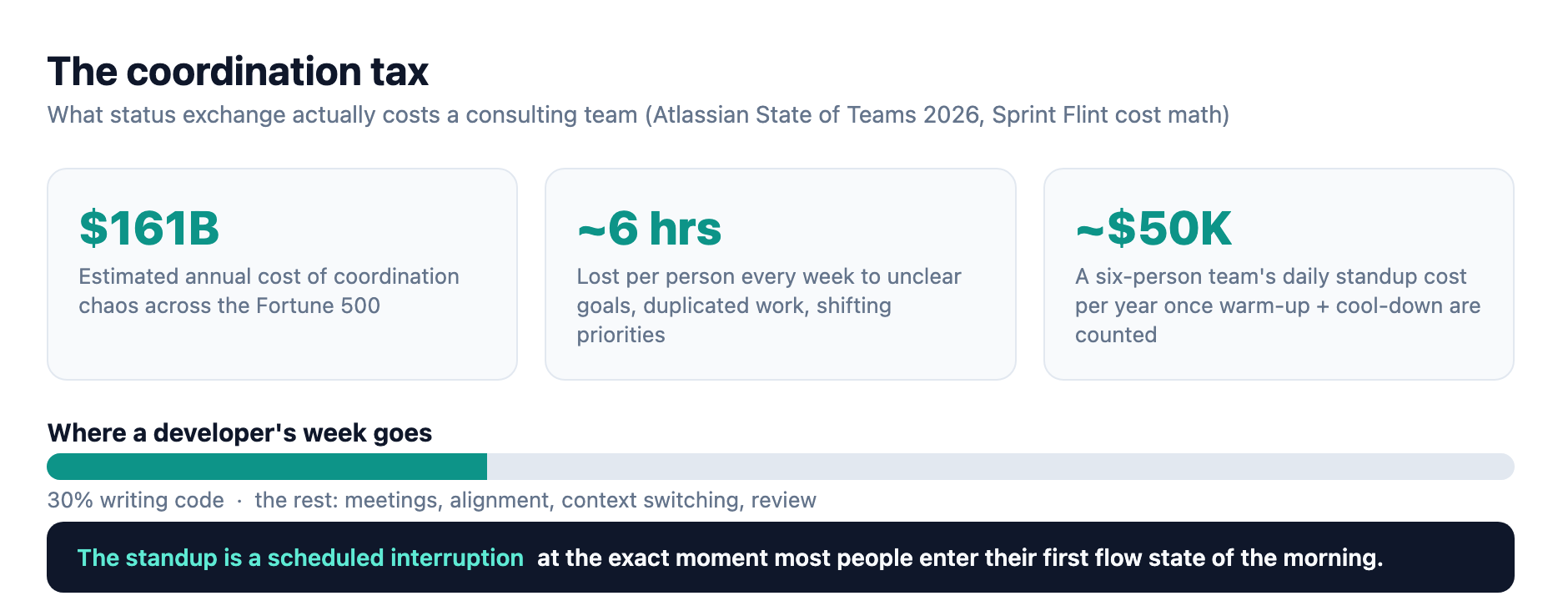
That distinction matters for consulting teams because the coordination cost is the first thing clients ask you to cut. Atlassian's State of Teams 2026 report, surveying more than 12,000 knowledge workers and executives, put a number on it: teams that say AI makes them faster still lose about six hours a person every week to coordination chaos, unclear goals, duplicated work, and shifting priorities. Across the Fortune 500 that adds up to roughly $161 billion a year. High-tax teams spend about 6.4 more hours per person per week on coordination overhead than low-tax teams. The teams that figure out how to coordinate around AI cut that tax nearly in half 34.
The standup sits right in the middle of that tax. It is the calendar block that everyone attends, that nobody enjoys, and that costs more than the fifteen minutes on the agenda. It is also the front ceremony in the same pipeline where planning stopped rationing effort and started routing it: that piece covered how a sprint decides what to build, and this one covers how the team learns each day whether the build actually moved.
The cost nobody runs
Do the arithmetic on a normal team. A six-person engineering team on mid-career salaries, running a fifteen-minute daily standup, spends about 1.5 person-hours per standup on the meeting itself. Across fifty weeks that is a five-figure annual cost before anything goes wrong 5. The compiled number from the Techademy agile practice is starker: a daily standup runs about 60 or more hours a year per team just reciting updates that could be a one-line message, and an async-first pattern returns more than 70 hours a year 6.
The real cost is bigger than the meeting. Developers spend roughly 30 percent of their time actually writing code and the rest on meetings, alignment, context switching, and reviewing other people's work. A GitHub study found that interruptions can erase up to 82 percent of productive work time, and the standup is a scheduled interruption that lands at the exact moment most people are entering their first flow state of the morning 1. Cal Newport's task-switching research puts the full refocus penalty in the tens of minutes. A tight standup eats close to an hour of effective time per engineer per day once warm-up and cool-down are counted 5.
An async-first standup cuts most of that. Each engineer posts a short update in a thread before a fixed time, a bot or language model compiles it into a team summary, blockers get flagged, and a five-minute live sync happens only if a blocker needs discussion. The team keeps a short connection meeting twice a week 6. The result is most of the coordination with almost none of the interruption tax.
What the agents changed
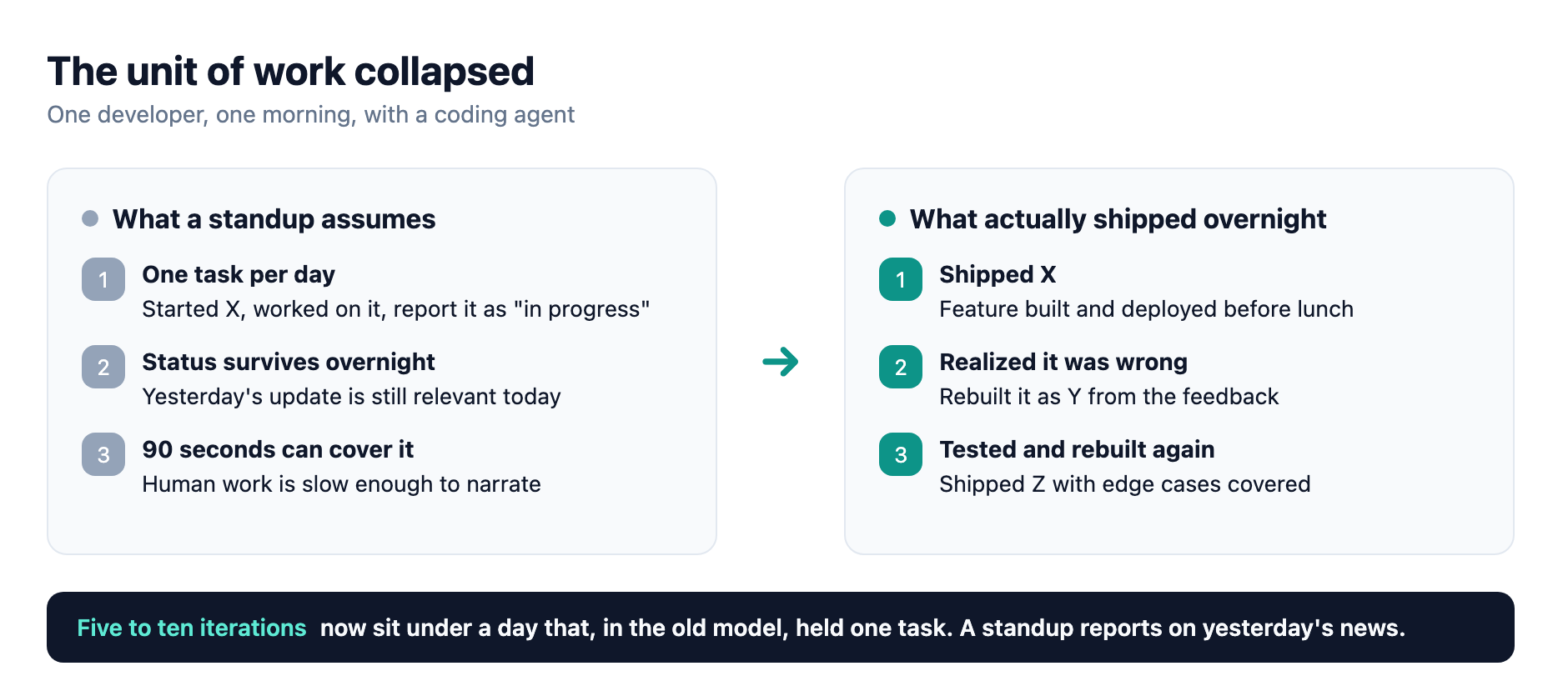
The critique that the standup cost too much existed long before agents. What agents changed is the unit of work, and that is the piece that makes the complaint final.
In the old model a developer completed one or two meaningful tasks a day. In the agent-assisted model the same person can complete five or ten iterations: shipped a feature, realized it was wrong, rebuilt it as Y, tested Y against three edge cases, deployed Z 1. The granularity of progress shifted from "I worked on X" to "I shipped X, then changed my mind twice." Capturing that in a ninety-second turn per person is trying to describe a movie by reading the chapter titles.
The scale data confirms it is not a corner case. The Q1 2026 AI Velocity report found 84 percent of code at early-adopter firms is now AI-authored, up from 51 percent in Q4 2025, with delivery 40 to 50 percent faster 7. When that much of the work happens without a human at the keyboard, the old standup fails two ways. Developers either ignore the agent output entirely, or they spend the whole standup narrating what their agents did overnight. Both are waste, and both are symptoms of the same design error: the ceremony still assumes the person is the author of the work.
The standup question was always the weakest part
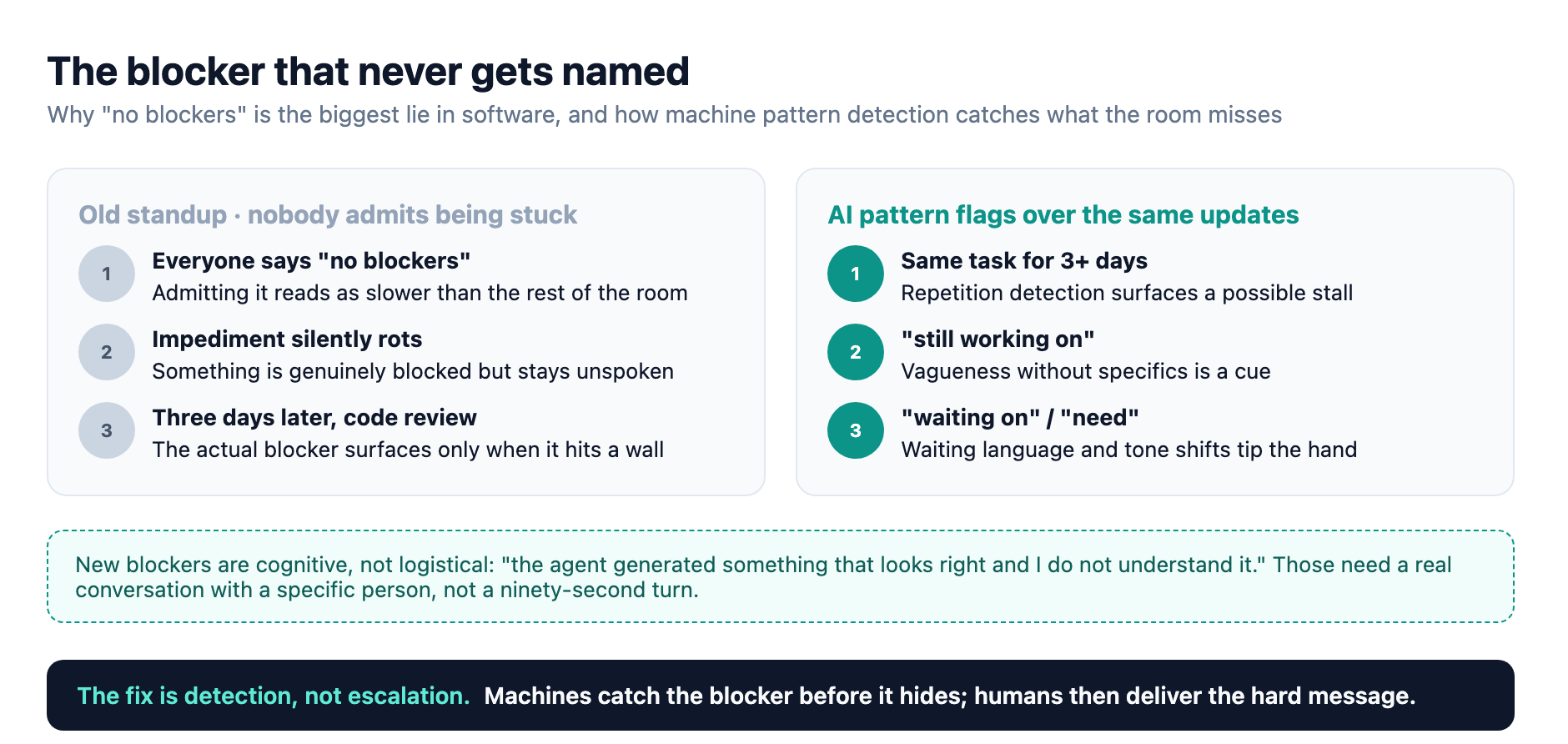
Anyone who has sat through decades of standups can tell you what the ritual actually teaches new people: nobody admits to being blocked. Admitting a blocker in a standup means admitting you are stuck, which means admitting you might need help, which reads as slower or less capable than the person who just said "no blockers" before you. So everyone says "no blockers," and the actual impediment sits there for another three days until code review finds it 1.
Agents did not fix that lie, they changed its shape. The old blockers were logistical: waiting on the API team, waiting on database access. The new blockers are cognitive: "the agent generated something that looks right and I do not fully understand what it does," or "I shipped three iterations and I am not sure which architectural approach is correct." Those need a real technical conversation with a specific person, not a ninety-second update to a room full of people half-checking Slack 1. A standup that never surfaces them is not a coordination ceremony, it is a theater of status.
The fix for this specific failure is detection, not escalation. A language model reading a week of standup updates can pattern-match the telltale signs: the same task appearing for three-plus days, "still working on" without specifics, "waiting on" and "blocked by" and "need," a shift in tone, a task description that keeps growing 6. Surfacing those patterns is where the machine does something the human room never did reliably. It catches the blocker before it hides.
Reverse the ceremony
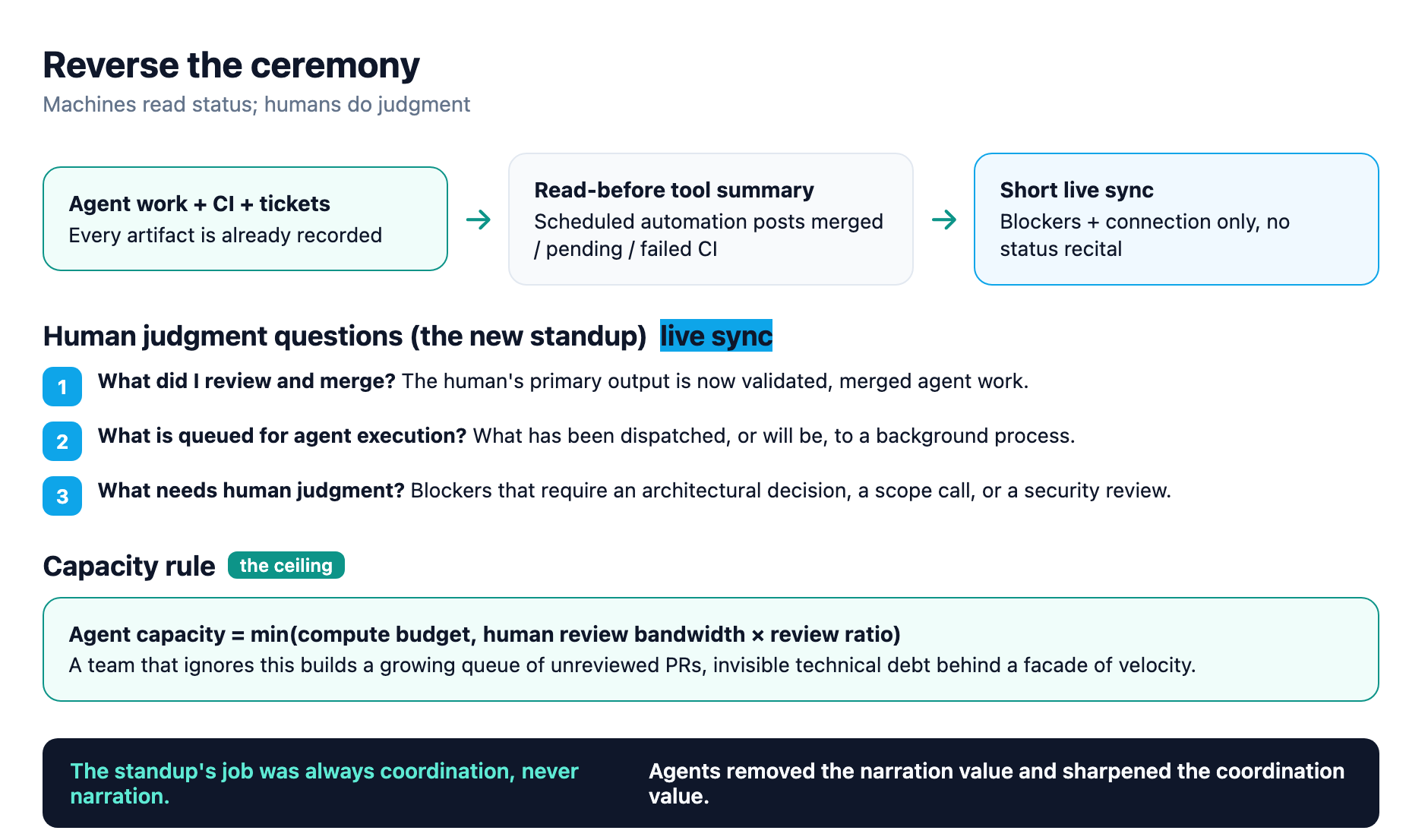
The redesign that has been converging across the practitioner guides is not a fancy one. It reverses the order of the standup so that machines read status and humans do judgment 268.
Machine status through tooling, not voice. The agent's output, the pull requests it opened, the state of CI, the tickets that did not move, all of that is already recorded. Surface it through a tool-generated summary that the team reads before any meeting. A scheduled automation can post a daily summary grouped by merged, pending review, changes requested, and failed CI 27. Team members stop narrating their agents and start reading a board.
Redesign the human questions. When most of the work happened autonomously, the standup questions change from "what did you do" to three that match where human judgment actually lives 2:
- What did I review and merge? The human's primary output is now validated, merged agent work.
- What is queued for agent execution? What was dispatched, or will be, to a background process.
- What needs human judgment? The blockers that require an architectural decision, a scope call, or a security review.
That reformulation matches the consulting reality, and it connects to the estimation discussion from earlier in this series: if story points measured human cognitive load, then an agent track at near-zero implementation cost stops measuring anything, and the review-and-merge question is what replaces the point value. A team's capacity is not agent throughput, it is the human review bandwidth under it. An agent can open fifty pull requests in a day and a four-person team can review maybe fifteen thoroughly. The capacity equation is: agent capacity equals the minimum of compute budget and human review bandwidth times a review ratio 27. A standup built around review-and-merge puts that ceiling in front of the team every morning instead of hiding it.
Keep the live sync for blockers and connection only. The hybrid pattern that keeps showing up works like this: async written updates by 09:00, a ten-minute live sync at 09:30 that reviews blockers only, no status recital, and live discussion limited to the two or three most pressing items 6. Distributed teams can push further: async is the only realistic option, because a fixed-time update means a six a.m. meeting somewhere in the world.
There is a common thread across all three moves. The standup's job was always coordination, never narration. Agents removed the value of the narration and sharpened the value of the coordination. The teams doing this well kept the ceremony that coordinates and dropped the half that performed.
The one guardrail: do not over-automate the connection
The failure mode most teams hit first is not clinging to the old standup, it is over-correcting. They turn the standup into a pure bot poll and then wonder why the team feels cold after a few months.
The practitioner guides are consistent about this. Async-only erodes relationships: teams should keep scheduled connection time, a weekly human check-in with no agenda, and intermittent social rituals 6. There is also a real ceiling on what summary automation should do. A machine can detect a repeated pattern and flag a shift in tone, but it should not be the one delivering the hard conversation. The summary is the input; the human delivers the message 8. And there is a subtle trap in making the summaries performance data. If managers read standup updates as a performance review, candor drops and the whole blocker-detection benefit evaporates 6. Name that explicitly with the team before you turn on the tooling.
For consulting teams the practical litmus is simple. If your standup produces a list of merged work and no pull requests, and the only blocker named is about a dependency that lives outside the team, you have a status report, not a coordination ceremony. Fix the ordering before you fix the tooling.
The standup is not obsolete. The status report is. Give the reading back to the tools, keep the room for the decisions, and the six hours a week your team was spending trying to figure out what anyone actually did starts becoming delivery time. The junior developer on that banking project did not need eight people to hear the news. He needed the person who could review his notification service, the architect who could have told him his error handling was wrong before he wrote it, and the room to ask for help when he was stuck. That is the standup worth showing up for.
Sources
-
Benjamim Castell, "The Daily Standup Is Obsolete in the Age of Vibe Coding," agilelie.com, March 10, 2026. agilelie.com ↩ ↩2 ↩3 ↩4 ↩5 ↩6
-
Daniel Vaughan, "Adapting Agile Ceremonies for AI Coding Agents: Sprint Planning, Standups, and Retros," codex.danielvaughan.com, April 12, 2026. codex.danielvaughan.com ↩ ↩2 ↩3 ↩4 ↩5 ↩6
-
Atlassian, "The AI efficiency paradox: What to do when AI boosts productivity but not results," State of Teams 2026. atlassian.com ↩
-
"Work About Work: The 2026 Coordination Crisis," coommit.com, May 2026. coommit.com ↩
-
"The hidden cost of your daily standup (run the math)," sprintflint.com. sprintflint.com ↩ ↩2
-
Paul Lister, "AI Daily Standups: Async, Smarter, and 50% Shorter," techademy.com, June 1, 2026. techademy.com ↩ ↩2 ↩3 ↩4 ↩5 ↩6 ↩7
-
"Q1 2026 AI Velocity Report: Real Delivery Data from 84% AI-Authored Code," Talk Think Do. talkthinkdo.com ↩ ↩2 ↩3
-
Gowtham, "How AI is Transforming the Daily Standup for Scrum Masters," agileseekers.com, August 10, 2026. agileseekers.com ↩ ↩2